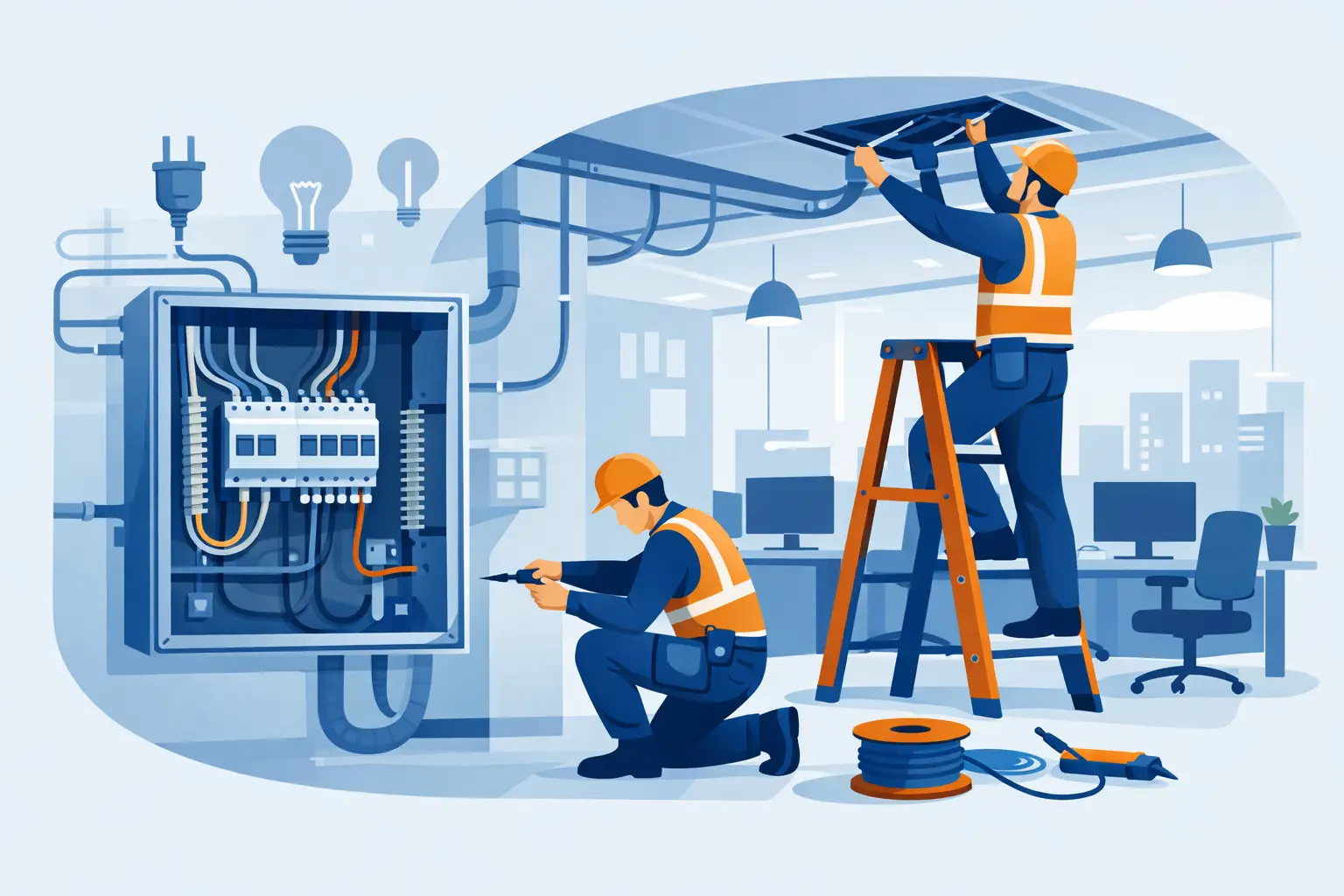
Picture an office floor where lights flicker, sockets trip under normal use, and the fire alarm panel keeps flagging faults. In most cases, the issue is not just a single fitting or one damaged cable. It comes back to the wider electrical system - which is why understanding what is commercial wiring matters if you own, manage or refurbish a business premises.
Commercial wiring is the electrical infrastructure designed to power and support non-domestic buildings such as offices, shops, warehouses, schools, restaurants, HMOs and mixed-use properties. It covers far more than lights and sockets. A proper commercial installation also needs to account for distribution boards, three-phase supplies, emergency lighting, fire alarms, data cabling, load demands, safety measures and ongoing compliance.
That is the main difference from a typical domestic setup. A house usually has simpler load patterns, fewer users and lower operational risk. A commercial property often has longer cable runs, heavier equipment, more circuits, stricter legal duties and a much greater need for continuity. If the wiring is wrong in a business setting, the cost is not only inconvenience. It can mean downtime, failed inspections, tenant complaints or safety breaches.
What is commercial wiring in practical terms?
In practical terms, commercial wiring is the system of cables, containment, protective devices and accessories that distributes electricity safely around a business premises. It starts at the incoming supply and extends through switchgear, boards, submains, final circuits and all connected equipment.
That can include standard power and lighting, but it often also includes systems that are essential to the way a building operates. Emergency lighting, fire alarm interfaces, security systems, landlord supplies in communal areas, air conditioning feeds, plant equipment, shutters, kitchen equipment and network cabling may all form part of the wider electrical scope.
The design depends heavily on the building and how it is used. A retail unit has different demands from a warehouse. A restaurant kitchen places different stresses on a system than a serviced office. An HMO or multi-let building can be especially complex because of shared services, landlord responsibilities and the need to separate tenant areas clearly.
Why commercial wiring is more complex than domestic wiring
The short answer is scale, risk and regulation. Commercial properties are generally busier environments with more people using the electrical system across longer hours. Equipment loads are also more varied. You may have lighting, computers, comms cabinets, extraction systems, refrigeration, heating controls and specialist machinery all operating on the same site.
That means the wiring needs to be planned rather than simply installed. Circuit loading, future expansion, discrimination, isolation, cable sizing and containment all matter. If one part of the system develops a fault, the aim is often to limit disruption rather than lose power across a whole floor or unit.
Commercial installations also tend to require more coordination with other trades and building systems. Electrical work may need to align with suspended ceilings, partition layouts, fire stopping, access control, emergency exits and mechanical equipment. In an occupied premises, the work may also need to be phased outside trading hours to reduce disruption.
The main components of a commercial wiring system
Every property is different, but most commercial installations are built around the same core elements. The incoming supply feeds the main distribution equipment, which then supplies smaller boards and circuits throughout the building. From there, the wiring serves lighting, power, fixed equipment and any life-safety systems.
Containment is a key part of the installation. In commercial settings, cables are often run in trunking, conduit, basket, tray or other protective routes rather than simply hidden in walls. This helps with durability, access and future alterations. In busy premises or plant areas, that level of protection is often essential.
Protective devices are equally important. Breakers, RCDs, RCBOs, surge protection and appropriate earthing arrangements are all there to reduce the risk of electric shock, fire and equipment damage. In some buildings, there may also be three-phase distribution, which is common where larger loads or plant equipment are involved.
Then there are the systems that people do not always think of as part of the wiring package but usually are. Emergency lighting, fire alarms, smoke control interfaces, door entry, CCTV power supplies, structured cabling and EV charging points can all sit within the wider commercial electrical design.
Compliance is not optional
For commercial property owners, landlords and managing agents, compliance is one of the biggest reasons to treat wiring seriously. Electrical systems in non-domestic premises must be safe, suitable for the environment and maintained properly. The exact legal duties depend on the type of building and how it is occupied, but the principle is straightforward: if people use the building, the electrical installation must not put them at risk.
That is where inspection and testing come in. An Electrical Installation Condition Report, or EICR, helps identify whether an existing system is satisfactory, whether there is deterioration, and whether remedial work is required. In rental and multi-occupancy settings, this becomes even more important because the wiring may be under regular strain and subject to changing use over time.
Compliance also affects insurance, tenancy obligations and day-to-day operations. A business with poor records or unresolved electrical defects may face problems far beyond the electrical system itself. It can delay lettings, create liability concerns and lead to avoidable disruption when faults become urgent.
Signs a commercial property may need rewiring or upgrade
Not every building needs a full rewire. Sometimes a targeted upgrade is enough. That said, there are clear signs that a system may no longer be fit for purpose.
Frequent tripping, overloaded circuits, ageing fuse boards, damaged accessories, poor test results and visible wear are all warning signs. So is a building that has been altered repeatedly over the years without a clear plan. It is common in older commercial premises to find ad hoc additions, mixed standards or circuits that no longer match the current layout and use of the space.
A change in occupancy can also trigger the need for review. If a quiet office becomes a busy clinic, or a storage unit is converted into a workshop, the original wiring may no longer suit the load or compliance needs. The same applies during refurbishments, fit-outs or change-of-use projects.
What a commercial wiring project usually involves
A professional commercial wiring project starts with assessment. That means understanding the building, how it is used, what equipment it needs to support and whether the existing installation can be retained, upgraded or replaced.
From there, the scope is developed. In some cases, it is a straightforward installation for a new unit. In others, it may involve phased rewiring while a business continues trading. That is why planning matters. The best results come from clear design, accurate load calculations, realistic programming and transparent pricing before work begins.
Installation is only one part of the process. Testing, certification, labelling and handover are just as important. A tidy-looking job is not enough if there is no proper verification behind it. For landlords and commercial operators, that paperwork is part of proving the system is safe and professionally delivered.
For clients across London and Kent, this is often where working with an electrical contractor that handles both installation and compliance makes life easier. Instead of juggling multiple parties, you get a practical route from survey through to certification and ongoing support.
Choosing the right approach
If you are asking what is commercial wiring, you are usually also asking a more practical question: what does my property actually need? The honest answer is that it depends on the building, the tenant or business use, the age of the installation and the level of risk.
A small office may only need additional sockets, better lighting control and updated testing. A restaurant may need new circuits, improved distribution and dedicated supplies for kitchen equipment. A multi-unit property may require landlord boards, emergency lighting, fire alarm integration and clearer separation of tenant services. There is no one-size-fits-all answer, which is why a site-specific assessment is always the right place to start.
Good commercial wiring is not just about getting power from one point to another. It is about safety, reliability and making sure the system supports the building properly now and in the future. When it is designed and installed well, people barely notice it - and that is usually the sign it is doing its job.