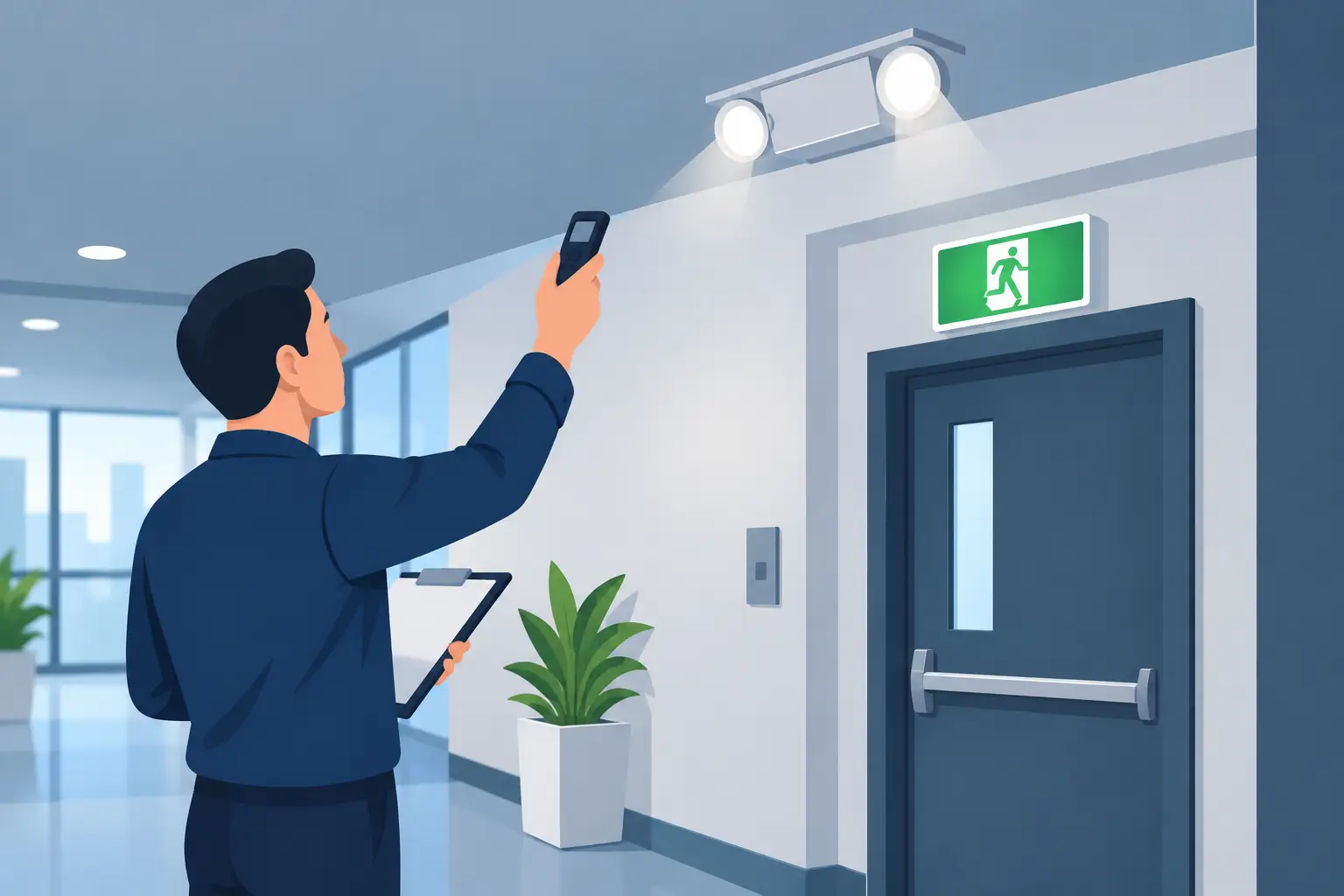
A green indicator LED is not proof that an emergency light will work when it is needed. The only reliable way to check is to simulate a loss of normal power and confirm that the fittings illuminate, provide usable light and remain operational for their required duration. Knowing how to test emergency lighting properly helps landlords, business owners and responsible persons protect occupants and maintain a safer, compliant building.
Emergency lighting is designed to guide people towards a safe exit when normal lighting fails. In an office, communal stairwell, HMO, shop, warehouse or block of flats, a failed fitting can turn an otherwise manageable power cut into a serious evacuation risk.
Why emergency lighting testing matters
Emergency lighting supports the safe evacuation of a building during a fire, electrical fault or loss of supply. It typically covers escape routes, stairs, changes of direction, fire alarm call points, firefighting equipment, open areas and externally illuminated exit routes.
The responsible person must make sure fire safety measures are maintained. The exact requirements depend on the building, its fire risk assessment, the emergency lighting design and the type of system installed. However, regular inspection, functional testing and clear records are fundamental expectations under relevant fire safety duties and British Standards guidance.
A fitting may appear undamaged during daylight hours but still have a failed battery, charger fault or lamp problem. Batteries deteriorate over time, especially where fittings are exposed to temperature changes or are not maintained. Regular testing identifies these faults before an emergency occurs.
Before you test emergency lighting
Plan the test so it does not create another safety issue. A test temporarily removes the normal electrical supply to the emergency lighting circuit, which can leave areas darker than usual. Carry out testing when disruption is low, but do not choose a time when the building is empty if no one will be able to identify and record faults.
Notify staff, residents, security personnel or contractors where appropriate. If your premises have a monitored fire alarm system, security system, lift controls or other equipment that could be affected by the test, follow the site procedure first. In larger or higher-risk premises, testing should form part of an agreed fire safety management plan.
You will need access to the emergency lighting test switch or key switch, a torch for recording results, and the emergency lighting logbook. Check that access routes are clear before starting. Do not use an electrical consumer unit or distribution board as a routine test switch unless the system has been specifically designed and labelled for this purpose.
How to test emergency lighting safely
Most self-contained emergency lights have an internal battery and change over automatically when their permanent live supply fails. Central battery systems are different and may need a more specialist procedure. Always follow the manufacturer’s instructions and the building’s testing arrangements.
Carry out a monthly functional test
A monthly test is usually a short functional check. Operate the dedicated emergency lighting test switch or test key to simulate failure of the normal supply. Every emergency fitting connected to that circuit should illuminate from its battery supply.
Walk the escape routes and look for fittings that do not come on, provide poor light, flicker excessively, show physical damage or have obscured lenses. Check that illuminated exit signs are visible and that key areas such as staircases, corridors and final exits remain adequately lit.
The test should be long enough to confirm that changeover occurs, but not so long that it unnecessarily drains the batteries. After restoring the supply, confirm that the charging indicators return to their normal condition. Record the date, test type, defects found and the action taken in the logbook.
Complete a full-duration test each year
The annual test is more demanding. The emergency lighting must operate for its full rated duration, commonly three hours, although the required duration can vary according to the system design and fire risk assessment.
Before beginning, make sure you can safely manage the reduced lighting level for the full period. Test at a time when occupants are unlikely to need the affected areas, and avoid periods where an evacuation risk, security concern or critical operation could make the test unsuitable.
Operate the dedicated test facility and leave the emergency lighting running for its specified duration. Near the end of the test, inspect the fittings and escape routes to confirm that the lights are still operating effectively. A light that comes on initially but fails after 30 minutes has not passed a three-hour duration test.
Restore the normal supply once the test is complete and check that charging resumes. Because batteries need time to recharge, avoid conducting a full-duration test immediately before the premises will be occupied or before another test is due. Record results and arrange repairs without delay.
What to check during each inspection
Testing is not just about whether a lamp lights up. Look at the building from an evacuee’s point of view. Can people see the route ahead, identify changes in level and locate the final exit without relying on normal lighting?
Pay particular attention to damaged diffusers, loose fittings, missing or faded exit legends, water ingress, signs of overheating and emergency lights blocked by stored items, displays or new partitions. Building alterations often create problems: a refurbished corridor, relocated doorway or changed office layout can leave an escape route inadequately covered even when every existing fitting works.
If you find a fault, label or isolate the defective fitting only where it is safe to do so, then arrange repair or replacement promptly. Do not simply write the issue in the logbook and leave it unresolved. Repeated faults can indicate a wider issue with charging circuits, the electrical supply, unsuitable fittings or a system that no longer matches the layout of the premises.
Keep an emergency lighting logbook
A clear logbook demonstrates that the system is being managed and gives an electrician useful information when faults need investigating. It can be paper-based or digital, provided it is accessible and completed consistently.
Your records should include the date and time of each test, the area or circuit tested, the name of the person carrying it out, any defects identified and the remedial action completed. Keep details of periodic inspections, replacement batteries, fitting upgrades and changes to the building layout alongside the test records.
For rented properties and managed buildings, this information also provides useful continuity when responsibility changes hands. It shows that safety checks have not been overlooked between tenants, contractors or managing agents.
When to call a competent electrician
A responsible person can often carry out straightforward monthly checks where there is a clearly labelled, dedicated test facility and a suitable procedure. However, an electrician should investigate failed fittings, persistent charger indicators, tripping circuits, damaged wiring, central battery systems and any uncertainty about the system’s coverage or duration.
Professional inspection is particularly valuable after a refurbishment, conversion, change of use or fire risk assessment review. An office converted into consultation rooms, for example, may have different escape-route needs. The same applies to HMOs, communal areas and commercial premises with changing occupancy or layouts.
PG Electrical can test, maintain and repair emergency lighting across Greater London and Kent, as well as assess whether existing coverage remains suitable for the premises. A competent inspection gives you a clear view of faults, remedial work and the condition of the system rather than relying on assumptions.
Common mistakes to avoid
One common mistake is pressing a local test button and assuming the entire system has been checked. A single fitting test does not prove that all lights on an escape route will operate. Another is performing the annual discharge test but failing to inspect the fittings near the end of the required duration.
It is also risky to test without a record. If a fault returns repeatedly, or if an incident prompts scrutiny of the system, a vague recollection of a previous test offers little protection. Finally, never postpone repairs because normal lighting is working. Emergency lighting exists for the moment normal lighting is unavailable.
A well-managed emergency lighting system is quiet reassurance for everyone using the building. Test it methodically, record what you find and act on defects quickly, so the escape route is visible when it matters most.