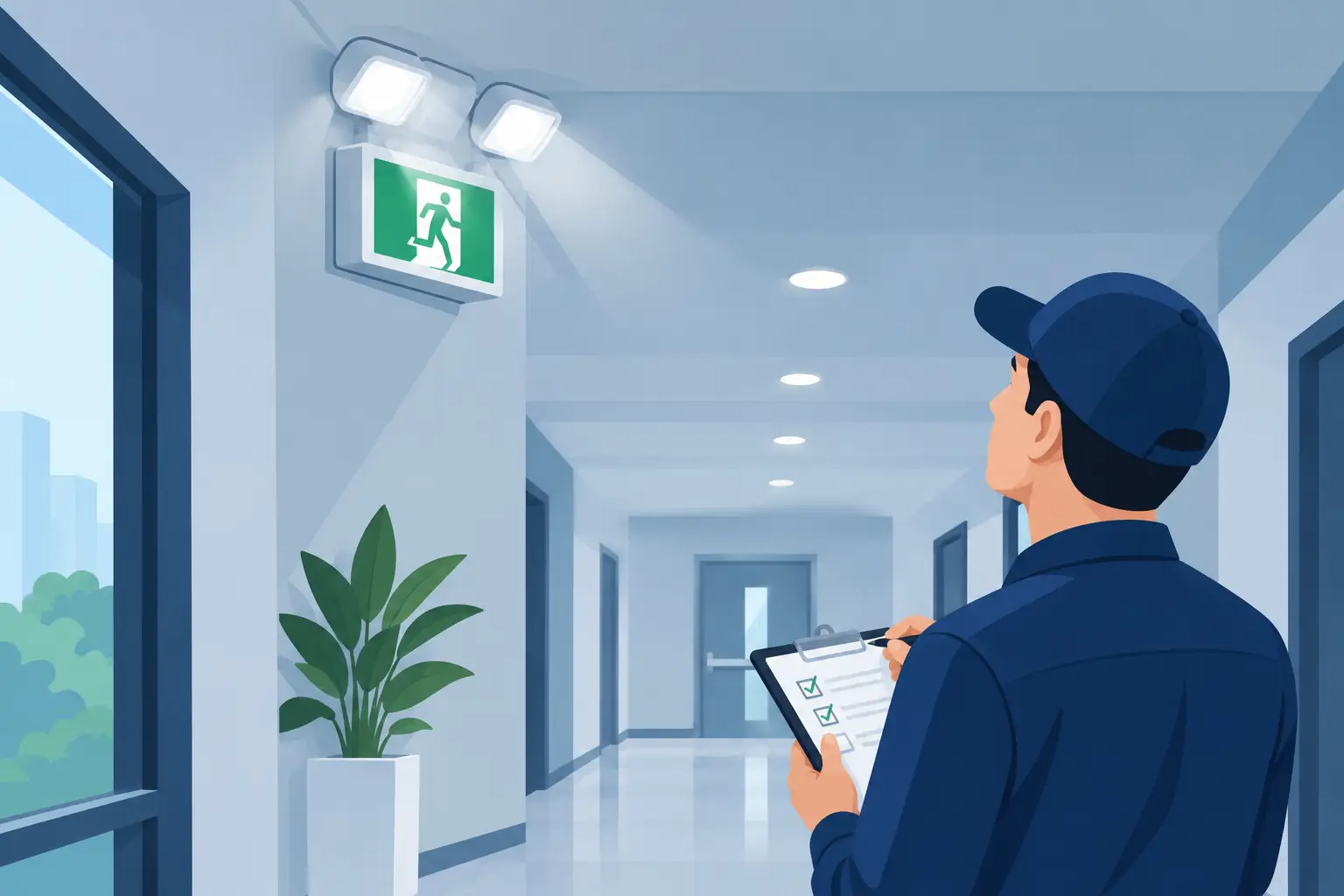
A power cut is the worst time to find that an emergency fitting has a failed battery or a missing lamp. Knowing when should emergency lights be tested helps landlords, business owners and responsible persons keep escape routes visible when normal lighting fails.
Emergency lighting is not a fit-and-forget installation. Batteries deteriorate, charging circuits can fail, and building alterations can leave areas poorly covered. A planned testing routine, recorded properly, gives you confidence that people can leave the premises safely in an emergency.
When should emergency lights be tested?
For most commercial premises, communal areas and multi-occupancy buildings, emergency lighting should be checked routinely and tested at set intervals. The precise approach should reflect the type of system, the building’s fire risk assessment and the manufacturer’s guidance, but the usual testing programme follows recognised British Standards guidance, including BS 5266.
A practical schedule normally includes a visual check each day, a short functional test each month and a full-duration test once a year. Systems may also require testing after installation work, changes to the layout, repairs or a long mains power failure.
The key point is simple: testing must prove that the lights operate from their emergency power source and remain on for the required duration, not merely that the indicator lamp appears healthy.
Daily and monthly emergency lighting checks
Daily visual checks
Where a premises has a central battery system or generator-backed emergency lighting, a responsible person should visually inspect the system indicators daily. This is generally a quick check for warning lights, fault messages or signs that the supply has failed.
Individual self-contained emergency fittings do not always need a daily inspection in the same way. However, staff should report damaged fittings, unlit charge indicators, water ingress, loose signs and anything blocking an emergency bulkhead or exit sign as soon as it is noticed.
Monthly functional tests
A monthly functional test is the routine test most premises need. The normal lighting supply is simulated as failed, usually using a test key switch or automatic test function, and each emergency luminaire should illuminate.
This test is deliberately short. Its purpose is to confirm that the fitting changes to battery power and provides light, without significantly draining the battery. Check that escape-route fittings, open-area lighting, high-risk task-area lighting and illuminated exit signs all operate where required.
Monthly testing should be planned carefully. In an office, shop, school, block of flats or warehouse, carry out the test at a time when reduced lighting will not create a hazard or disrupt normal operations. If a test takes place during opening hours, ensure occupants are not exposed to dark escape routes.
Annual duration tests: the test that proves battery performance
At least once a year, emergency lighting should undergo a full-duration discharge test. This is the more demanding inspection because it confirms that batteries can sustain the required emergency period, commonly one or three hours depending on the building design and fire strategy.
During this test, the normal lighting supply is interrupted or simulated as interrupted for the full rated duration. Every emergency fitting and exit sign should remain operational throughout. A light that comes on initially but fades, flashes or fails before the end of the test does not meet the requirement.
The annual duration test should be carried out when the premises can safely operate with normal lighting affected, or when the area is unoccupied. This is particularly relevant in care settings, occupied residential buildings, busy retail spaces and sites operating late shifts.
After the test, batteries need time to recharge fully. Many systems require up to 24 hours before they are ready to provide their full emergency duration again. Avoid carrying out a full discharge test immediately before a period when the building has a higher fire risk or will be heavily occupied.
Test emergency lighting after changes, faults and power loss
Fixed testing intervals are essential, but they are not the only trigger. Emergency lighting should also be inspected and, where appropriate, tested in the following situations:
- after a new system is installed or an existing installation is extended
- after electrical alterations, building works or changes to escape routes
- following replacement of batteries, fittings, lamps or control gear
- after a reported fault, damage, water leak or fire-related incident
- after an extended mains failure that may have significantly discharged the batteries
Building changes are often overlooked. A new partition, racking layout, suspended sign or altered doorway can affect the light available on an escape route. Emergency lighting needs to match how people will actually leave the building, not how it was arranged several years ago.
What should be recorded in the emergency lighting logbook?
Testing is only as useful as the evidence behind it. The responsible person should maintain an emergency lighting logbook or equivalent digital record. This should show the date and time of each test, the areas or fittings checked, the result, any fault found, action taken and the name of the person carrying out the check.
For annual tests, record the intended duration and whether the system maintained illumination for the whole period. If a fitting fails, it should be repaired promptly and the remedial work logged. Simply recording a failure without arranging a repair leaves the building exposed.
Clear records are valuable during fire risk assessments, inspections and insurance enquiries. More importantly, they show that emergency lighting maintenance is being managed rather than assumed.
Who is responsible for testing emergency lights?
Under the Regulatory Reform (Fire Safety) Order 2005, the responsible person must take reasonable steps to ensure fire safety systems are maintained. In practice, this may be a business owner, employer, landlord, managing agent, facilities manager or another person with control of the premises.
Routine monthly checks can often be completed by a trained member of staff who understands the test process and knows how to record defects. Annual duration testing, fault diagnosis, commissioning and remedial works are often better handled by a competent electrical contractor, especially where systems are larger, centrally supplied or connected to fire alarm controls.
For landlords, responsibilities vary with the property. Emergency lighting is commonly required in communal escape routes, HMOs and certain higher-risk rental arrangements. A single private dwelling has different requirements from a block with shared corridors and stairwells. The fire risk assessment and property layout should guide the decision.
Common problems found during emergency lighting tests
The most common issue is battery failure. Emergency fittings may still show a charge indicator but have insufficient battery capacity to last through the rated duration. Older fittings can also suffer from failed LEDs, defective chargers, damaged diffusers or incorrect lamps.
Another frequent problem is poor positioning. Emergency lighting may work perfectly but fail to illuminate a change in direction, a stairwell, a final exit or fire equipment adequately. Exit signs can also become obscured after refurbishment or changes to internal layouts.
Automatic self-test fittings reduce the manual testing burden, but they do not remove the need for oversight. Fault indicators must be reviewed, records must be retained and a competent person still needs to investigate failures. An automated result is helpful only if somebody acts on it.
How PG Electrical can help
PG Electrical provides practical emergency lighting support for commercial premises, landlords and property managers across Greater London and Kent. This can include condition checks, functional and duration testing, fault finding, replacement fittings, new installations and clear test records for your compliance file.
If your emergency lighting has not been tested recently, do not wait for the annual review to discover a fault. Arrange an assessment, address any failed fittings and set a testing schedule that suits the way your building operates. Safe escape routes depend on equipment that works when normal power does not.