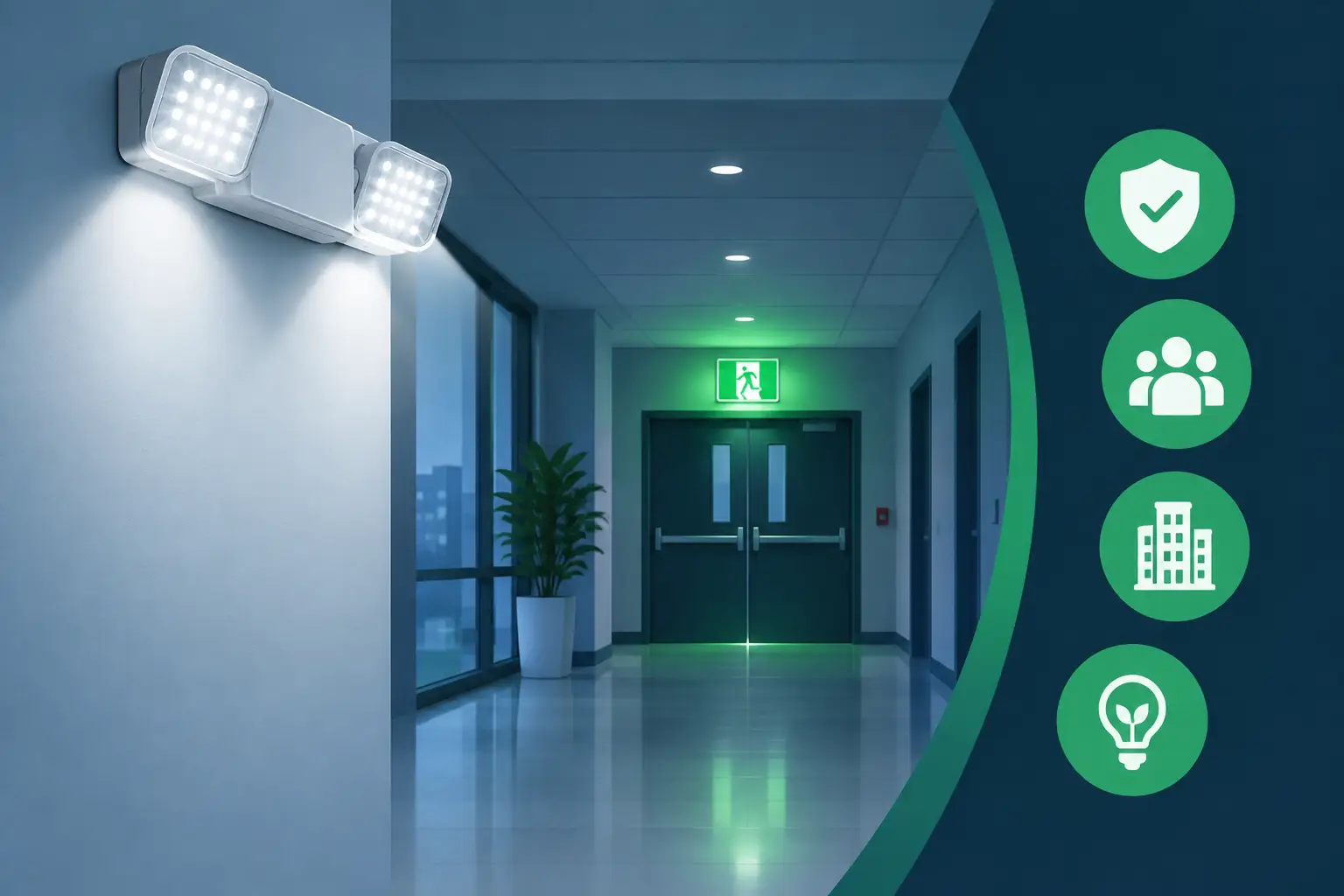
When the normal supply fails, people need to see the route out without hesitation. The practical LED emergency lighting benefits for landlords, business owners and property managers are clear: reliable illumination during an outage, reduced running costs and a system that is easier to maintain over its working life. In offices, HMOs, retail units and communal areas, that can make a meaningful difference to safety and compliance.
Emergency lighting is not simply a collection of lights that operate during a power cut. It is part of a building’s wider life-safety provision. The right design must account for escape routes, open areas, changes in level, fire equipment, exit signs and the way occupants actually use the premises.
Why LED emergency lighting is now the sensible choice
Older emergency lighting systems often use fluorescent lamps or less efficient lamp types. They can work effectively when correctly installed and maintained, but LEDs have become the practical default for most new installations and upgrades.
LED fittings use considerably less electricity in normal operation. This matters particularly for maintained emergency lights, which remain illuminated while the mains supply is available and then continue operating from their battery during a failure. Lower demand can reduce ongoing costs across larger buildings with multiple fittings.
LEDs also have a far longer expected lamp life than traditional alternatives. Fewer lamp changes mean less disruption in busy premises, reduced maintenance visits and less risk of a fitting being left in poor condition between inspections. For property managers responsible for several sites or blocks, that improved consistency is a real operational benefit.
The upfront cost of an LED fitting can be higher than a basic older-style replacement, depending on the specification. However, the total cost of ownership is often lower once energy consumption, lamp replacements and access costs are considered. A site survey is the best way to establish whether a like-for-like replacement or a full LED upgrade represents better value.
Better visibility where it matters most
Emergency lighting has one central job: helping people reach a place of safety when normal lighting is unavailable. LEDs provide bright, instant illumination, which is especially useful during sudden power loss. There is no warm-up period while occupants are trying to find an exit.
A properly designed system should illuminate more than a corridor. It needs to support safe movement along escape routes and draw attention to critical points, including final exits, stairways, changes of direction, first-aid points, firefighting equipment and manual fire alarm call points where required.
Clearer escape routes in shared buildings
In an HMO, block of flats, office or commercial unit, occupants may not know every route through the building. A well-positioned LED emergency system makes the route easier to follow, even if smoke, stress or unfamiliar surroundings make decision-making difficult.
Light levels, fitting positions and signage must be considered together. A bright fitting in the wrong location does not create a compliant escape route. Equally, an exit sign that is obscured by shelving, decorations or a later refurbishment may fail to guide people when it is needed. This is why emergency lighting should be reviewed whenever a layout, use or occupancy level changes.
LED emergency lighting benefits for maintenance budgets
For many duty holders, maintenance is where the value of LED emergency lighting becomes most visible. Long-life LEDs reduce the frequency of routine lamp replacement, and modern fittings are available with features that simplify inspection and fault finding.
Self-test emergency lights can carry out scheduled functional checks automatically and indicate when there is a fault. This can save time on larger sites and help identify issues before an annual inspection. They do not remove the need for responsible record keeping or professional servicing, but they can make day-to-day management more straightforward.
Battery condition still matters. Emergency luminaires rely on a battery to provide light for the required duration when mains power fails. LED technology reduces the load on that battery, which can support efficient operation, but batteries have a finite service life and must be tested and replaced when necessary.
For landlords and facilities teams, fewer replacement lamps and clearer fault indication can also mean fewer avoidable visits. That said, access arrangements, high ceilings and the number of fittings all affect the maintenance cost. A simple common-area installation and a multi-storey commercial premises will require very different maintenance plans.
Supporting compliance without treating it as a box-ticking exercise
Emergency lighting in the UK is commonly designed, installed and maintained with reference to BS 5266. The exact requirements depend on the building, its fire risk assessment, occupancy, escape strategy and the type of emergency lighting system in place.
There is no single fitting or layout that suits every property. A small office with one clear exit may need a straightforward arrangement. A warehouse, care setting, HMO or building with multiple floors will usually need more detailed planning. Existing lighting, daylight levels, travel distances and areas of particular risk must all be assessed.
Routine testing is essential. Monthly functional checks confirm that fittings change to emergency operation, while a full discharge test is generally required at longer intervals to prove that the system can operate for its intended duration. Tests should be recorded in an emergency lighting logbook, and faults should be addressed promptly.
It is worth remembering that compliance is not achieved by fitting products alone. If batteries have failed, signs are poorly located, circuits have been altered or test records are missing, the system may not provide the protection expected during an emergency. Professional inspection gives building owners and responsible persons a clearer picture of what needs attention.
Choosing the right LED emergency lighting system
The choice between maintained and non-maintained fittings is often the first decision. Maintained emergency lights operate continuously from the normal supply and switch to battery power when the supply fails. They are often used where the fitting also forms part of normal lighting or where an illuminated sign is needed at all times.
Non-maintained fittings remain off during normal conditions and operate only when there is a power failure. They can be suitable where normal lighting already provides adequate illumination and permanent lighting from the emergency unit is not required.
Central battery systems, self-contained fittings and addressable monitoring each have their place. Self-contained LED units are often cost-effective and practical in smaller premises. Larger or more complex buildings may benefit from centralised or monitored systems that make testing and fault reporting easier to manage. The right option depends on the building, budget and the level of control required.
When an upgrade is worth considering
An upgrade is particularly worth discussing if existing emergency lights are old, difficult to maintain, visibly damaged or regularly failing tests. It is also sensible to review the system after a refurbishment, change of use, extension or alteration to escape routes.
Replacing individual failed fittings may be appropriate where the existing design remains suitable and compatible replacements are available. A wider LED upgrade is often more cost-effective when fittings are nearing the end of their life, maintenance costs are rising or the installation no longer reflects the current layout of the property.
At PG Electrical, emergency lighting work begins with understanding the building and its safety requirements, not with selling a standard package. A clear assessment can identify whether you need replacement fittings, a redesigned system, routine testing or fault repairs, with practical advice on the most suitable route forward.
Reliable emergency lighting is easy to overlook while normal power is available. Reviewing it before a fault, inspection or emergency gives occupants a safer route out and gives those responsible for the property greater confidence that the system will perform when it counts.