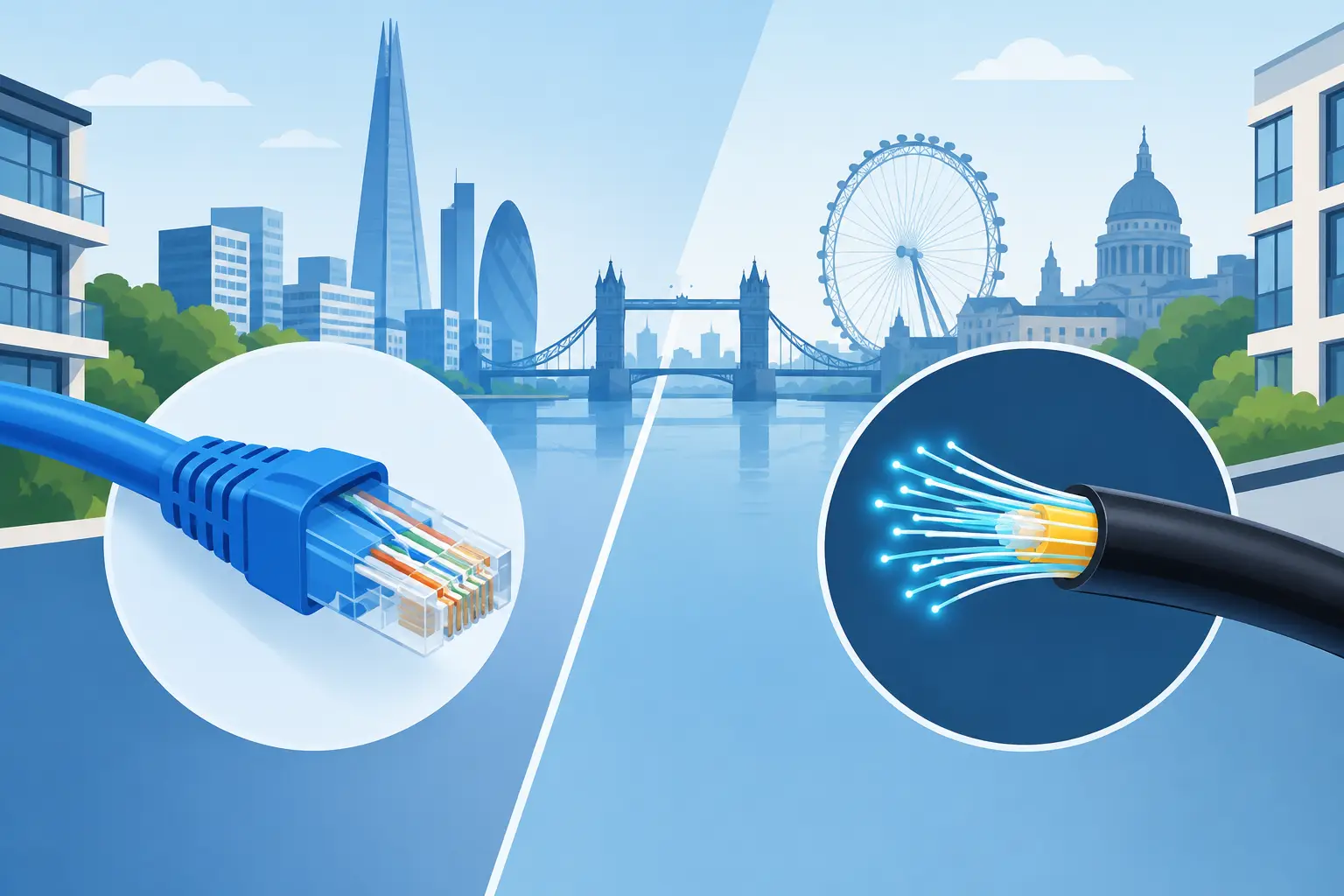
A slow network is not always a broadband problem. In many homes, offices and multi-unit properties, the real limitation sits behind the walls: ageing cables, poor routing or a network that was never designed for modern demand. When considering cat6 vs fibre cabling, the right choice depends on how far data must travel, what equipment needs connecting and how the property may change over time.
For a typical house, flat, small office or managed rental property, Cat6 structured cabling is often the practical and cost-effective answer. Fibre becomes the stronger option where distances are greater, bandwidth demands are higher or separate buildings need a reliable connection. A professional survey should look beyond headline speeds and assess the full installation, including containment, power requirements, access points, switches and future expansion.
Cat6 vs fibre cabling: the key difference
Cat6 is a copper Ethernet cable commonly used for structured data networks. It connects devices such as computers, Wi-Fi access points, smart TVs, printers, CCTV cameras, network switches and phone systems through standard RJ45 outlets. It is familiar, versatile and well suited to the majority of local-area network installations.
Fibre optic cable carries data using light rather than electrical signals. It is designed for high capacity connections over much longer distances and is not affected by electromagnetic interference in the same way as copper cabling. Fibre is commonly used as a backbone between comms cabinets, across larger commercial premises, or from a main building to an outbuilding, warehouse or separate block.
Both can form part of the same installation. A well-planned commercial network may use fibre between floors or buildings, then Cat6 to serve individual desks, access points and connected equipment. This is often more sensible than treating the decision as an either-or choice.
When Cat6 is the better choice
Cat6 remains a dependable standard for most domestic and light commercial projects. It is capable of supporting Gigabit Ethernet at lengths up to 100 metres, which is more than enough for normal broadband use, video calls, cloud working, streaming and connected home technology. Under the right conditions, Cat6 can also support 10 Gigabit speeds over shorter cable runs.
For a homeowner renovating a property, Cat6 can provide hardwired connections to a home office, media room, loft access point, doorbell system or CCTV recorder. Wired connections reduce reliance on Wi-Fi and can improve consistency where walls, steelwork or neighbouring networks affect wireless coverage.
In offices and rental properties, Cat6 is equally useful for workstations, VoIP telephones, wireless access points and security systems. It can also deliver Power over Ethernet, known as PoE. This allows certain devices, including many CCTV cameras, access points and door entry units, to receive power and data through one correctly specified cable. Fibre cannot supply PoE, so additional power arrangements are required at the device end.
Cat6 is generally easier and less costly to terminate than fibre. The components are widely available, fault-finding is straightforward and compatible equipment is common. For smaller properties where cable routes are reasonably short, these practical advantages matter.
The limits of Cat6
Copper cabling has distance and environmental limitations. Performance reduces as runs become longer, particularly where higher network speeds are required. Cat6 may also need careful separation from electrical cables and other sources of interference. This is especially relevant in commercial spaces with plant equipment, large electrical installations or busy service routes.
The cable itself is also thicker and less flexible than some older data cables, so route planning matters. Tight bends, poor termination, unsuitable containment and unlabelled outlets can all undermine the performance of an otherwise good installation.
Where a project requires 10 Gigabit networking throughout over full 100-metre channel lengths, Cat6A is often considered instead of standard Cat6. It is a larger cable and can cost more to install, but it provides stronger performance for higher-specification networks.
When fibre cabling makes more sense
Fibre is the preferred option when data needs to travel beyond copper Ethernet’s practical range. If you are connecting a main office to a separate workshop, linking buildings across a site, or running a backbone between floors in a larger development, fibre can deliver speed and reliability without the same distance constraints.
It is also a strong choice for networks carrying high volumes of data. Businesses using central servers, large CCTV systems, cloud backups, high-density Wi-Fi or multiple high-bandwidth users may benefit from a fibre backbone. The same applies to larger blocks where several comms cabinets or riser cupboards need connecting back to a central point.
Unlike copper, fibre is non-conductive. It does not carry electrical current and is highly resistant to electromagnetic interference. In the right setting, this can improve reliability and help avoid issues caused by electrical noise. It can also be useful where buildings have different electrical earthing arrangements, although the wider electrical and network design must always be assessed properly.
Fibre offers considerable capacity for future expansion. Installing suitable fibre while routes are accessible can avoid disruptive work later, especially in refurbished offices, new developments and buildings with limited riser or ceiling access.
Fibre has different installation requirements
Fibre is not automatically the best value choice. The cable, terminations, optical modules and testing equipment can all add to the project cost. Installation requires specialist handling, precise termination and optical testing to confirm the completed link performs correctly.
It also needs active equipment at each end, usually switches or media converters fitted with compatible fibre ports. If a camera, access point or other device requires PoE, it will still need a local copper connection or a separate power supply from the network endpoint.
There are different fibre types, including multimode and single-mode fibre. Multimode is commonly used for shorter high-speed links within buildings, while single-mode is often selected for longer distances and greater future capacity. The right specification should be based on the route length, required equipment, expected data demand and future plans, rather than selecting cable on price alone.
Cost is more than the cable price
Comparing Cat6 and fibre solely by the metre can lead to the wrong decision. The total cost includes survey work, route preparation, containment, fire stopping, outlets or termination panels, cabinet space, switches, testing, labelling and making good after installation.
A short Cat6 run to a home office may be simple and economical. A fibre link to a detached building may cost more at the outset but could prevent repeated network failures, poor speeds and later excavation or redecorating. Conversely, fitting fibre to every individual desk in a modest office could add unnecessary cost where Cat6 meets the operational requirement perfectly.
For landlords and property managers, reliability and maintainability deserve particular attention. Clearly labelled cabling, sensible cabinet layouts and up-to-date test results make future alterations and fault diagnosis far easier. These details are often overlooked during a fast refurbishment, then become expensive when tenants, cameras, access control or Wi-Fi systems need changing.
Planning a cable installation properly
The best installations begin with how the property will be used, not with a cable type. Consider where broadband enters the building, where the main network equipment will sit, which rooms need fixed connections and where reliable Wi-Fi coverage is essential. Think about CCTV, alarms, door entry, smart controls, EV-related connectivity and any likely extension or outbuilding.
For commercial sites, it is also worth allowing capacity for extra staff, meeting rooms, additional access points and future tenants. Running spare cables or installing accessible containment during refurbishment is usually far more cost-effective than opening finished walls later.
Cable routes should be installed neatly, protected from damage and appropriately separated from electrical services. Fire stopping must be reinstated where cables pass through fire-rated walls or floors. Testing and labelling are not optional finishing touches: they provide evidence that every installed link is working as intended and can be identified later.
PG Electrical can assess the practical demands of a home, rental property or workplace and specify structured Cat6, fibre backbone cabling or a combined solution. The aim is not to over-specify a system, but to install a safe, tidy and dependable network that supports the property properly.
The right cable is the one that gives your property enough capacity today without creating avoidable disruption or cost tomorrow. A short site assessment before walls are closed, ceilings are renewed or tenants move in can make that decision much clearer.