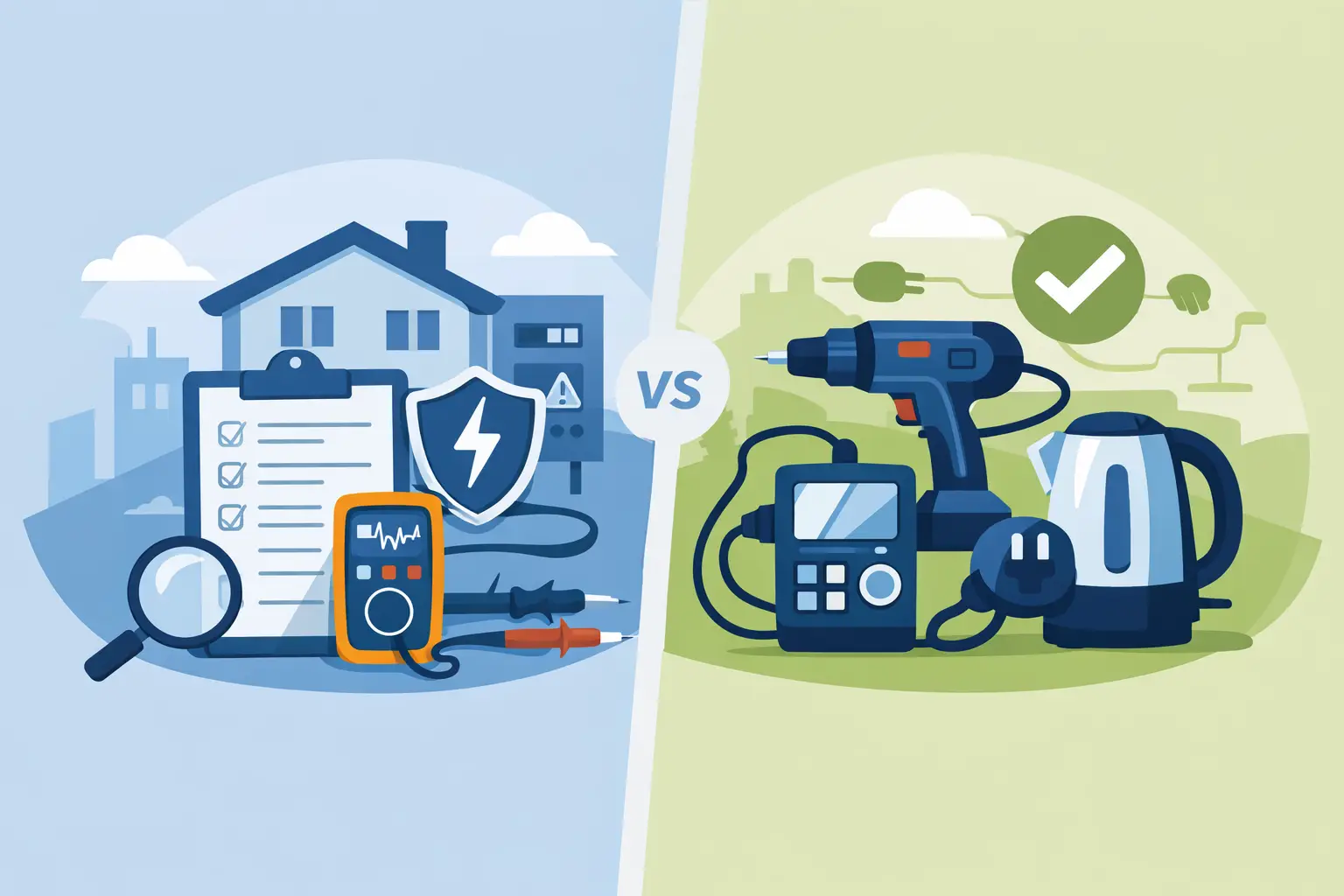
A kettle with a damaged flex and a loose connection behind a consumer unit can both create an electrical risk, but they are not found by the same type of inspection. That is the key difference in eicr vs pat testing. One assesses the fixed electrical installation in a property; the other focuses on portable electrical equipment connected to it.
For landlords, business owners and property managers, knowing the distinction avoids compliance gaps, unnecessary testing and the false reassurance of having the wrong certificate. For homeowners, it helps identify which service is appropriate when buying, renovating or maintaining a property.
EICR vs PAT testing: the essential difference
An Electrical Installation Condition Report, usually called an EICR, examines the permanent electrical system. This includes the consumer unit, circuits, wiring, sockets, switches, lighting points, earthing and protective devices. The purpose is to establish whether the installation is safe for continued use and whether it complies with the standards applicable to its age and condition.
PAT testing means Portable Appliance Testing. It concerns electrical appliances that are plugged in, moved or could be moved, such as kettles, extension leads, computers, printers, fans, microwave ovens, power tools and cleaning equipment. The test looks at the appliance, plug and cable, with electrical checks carried out where appropriate.
Put simply, an EICR asks whether the property’s electrical infrastructure is safe. PAT testing asks whether individual plug-in items are safe to use. Neither replaces the other.
What an EICR checks
An EICR is a detailed inspection and test of the fixed installation. An electrician will normally need access to the consumer unit and representative parts of each circuit, which can include socket outlets, light fittings and wiring routes where accessible. Some testing requires circuits to be temporarily isolated, so planning is particularly important in occupied homes, offices, shops and multi-unit buildings.
The report records the installation’s condition and identifies defects using observation codes. A C1 observation indicates immediate danger. A C2 observation identifies a potentially dangerous condition that needs urgent attention. FI means further investigation is required without delay, while C3 is an improvement recommendation rather than a reason for an unsatisfactory report.
An EICR may reveal issues such as inadequate earthing, overloaded circuits, damaged accessories, poor previous work, unsuitable protective devices or deterioration caused by age, moisture or alterations. It is not designed to certify every appliance plugged into the sockets. A socket can test correctly even if a connected extension lead is damaged.
For rented homes in England, landlords must have the fixed electrical installation inspected and tested at least every five years, or sooner if the report recommends it. A copy of the report must also be provided to tenants and, where required, the local authority. The obligation applies to the installation, not to a tenant’s personal appliances.
Commercial premises have different duties, but employers and those responsible for workplaces must maintain electrical systems so they do not present danger. The appropriate EICR interval depends on the property type, how it is used and the level of risk. A busy workshop, for example, usually needs a more frequent inspection programme than a low-use office.
What PAT testing checks
PAT testing begins with a visual inspection. This is often the most valuable part of the process because many faults are visible: split cables, cracked plugs, loose pins, scorch marks, missing cable grips or equipment used in unsuitable conditions.
Where the appliance class and construction require it, the electrician then carries out electrical tests. These can include earth continuity for Class I equipment, insulation resistance and polarity checks. The result is recorded as pass, fail or requiring further action, giving the responsible person a clear equipment record.
PAT testing is especially useful where appliances are supplied for others to use. That may include a landlord-provided microwave in a furnished let, kettles and monitors in an office, maintenance tools, salon equipment, communal laundry appliances or extension leads used by a facilities team.
There is no single legal rule stating that every item must receive a PAT test annually. The legal duty is to maintain equipment so it is safe. Testing frequency should be based on risk, taking account of the appliance type, user behaviour, environment, age and previous results. A desktop monitor in a controlled office may need less frequent formal testing than a power tool used daily on a construction site.
Do landlords need both services?
Often, yes, but for different reasons. A landlord in England needs a valid EICR for the fixed installation in a rental property. If they provide portable appliances as part of a furnished tenancy or in communal areas, they also have a duty to ensure those appliances are safe. PAT testing is a practical way to demonstrate that the equipment has been checked and managed properly.
The position changes where appliances belong to the tenant. A landlord is not generally responsible for testing a tenant’s own toaster, television or laptop. However, any appliance supplied with the property should be maintained, and damaged items should be removed from use promptly.
In an HMO, a block with communal facilities or a commercial managed property, separating responsibilities is essential. The fixed installation may be covered by an EICR, while communal appliances, cleaners’ equipment and landlord-supplied items need an appliance register and a sensible inspection schedule. Clear records make handovers, audits and incident investigations far easier to manage.
When a homeowner should choose an EICR or PAT test
Homeowners commonly request an EICR when purchasing an older property, before major renovation work, after flood or fire damage, when recurring faults occur, or if the wiring has not been checked for many years. It is also sensible after significant alterations, particularly if you are adding an EV charger, converting a loft or installing a new kitchen with high-demand appliances.
PAT testing is less commonly needed in a typical owner-occupied home unless you run a business from the property, use professional electrical tools or provide appliances in a holiday let. A visual check remains worthwhile for everyone. Do not continue using an appliance with a damaged cable, loose plug, overheating smell or intermittent power supply.
If sockets trip regularly, lights flicker or you receive electric shocks or tingles from metalwork, arrange an electrical inspection rather than relying on appliance testing. These symptoms may point to a fixed-wiring fault that PAT testing cannot diagnose.
Can PAT testing be carried out during an EICR?
Yes, both services can be arranged together, and this is often the most efficient option for landlords and businesses. They still produce separate records because the scope, test methods and results are different. Combining the visit can reduce disruption, but it should never blur the distinction between safe circuits and safe appliances.
Before the appointment, make a list of appliances to be included and identify equipment that cannot be switched off during normal working hours. For an EICR, tell the electrician about sensitive systems such as servers, alarms, refrigeration, medical equipment, access control or production machinery. A planned approach protects operations while allowing testing to be completed properly.
Choosing the right testing schedule
The right schedule is not simply the shortest interval available. Over-testing low-risk equipment may add cost and disruption without improving safety, while under-testing equipment in harsh or high-use settings leaves a genuine gap. The best approach combines appropriate formal testing with routine user checks and prompt repairs.
For fixed installations, follow the recommended next-inspection date on the most recent satisfactory EICR, unless the property’s use changes or there is reason to suspect damage. For appliances, keep a register, record inspections and test more frequently where equipment is portable, heavily used, handled by the public or exposed to dust, moisture and physical impact.
A professional electrician can assess both sides of the equation: the circuits supplying the power and the appliances using it. PG Electrical can help property owners across Greater London and Kent plan EICRs, PAT testing and remedial work around the needs of occupied homes and working premises.
Electrical safety is easier to manage when it is treated as an ongoing responsibility rather than a certificate chase. Check what is fixed, check what is plugged in, keep clear records and act on faults before they become an emergency.