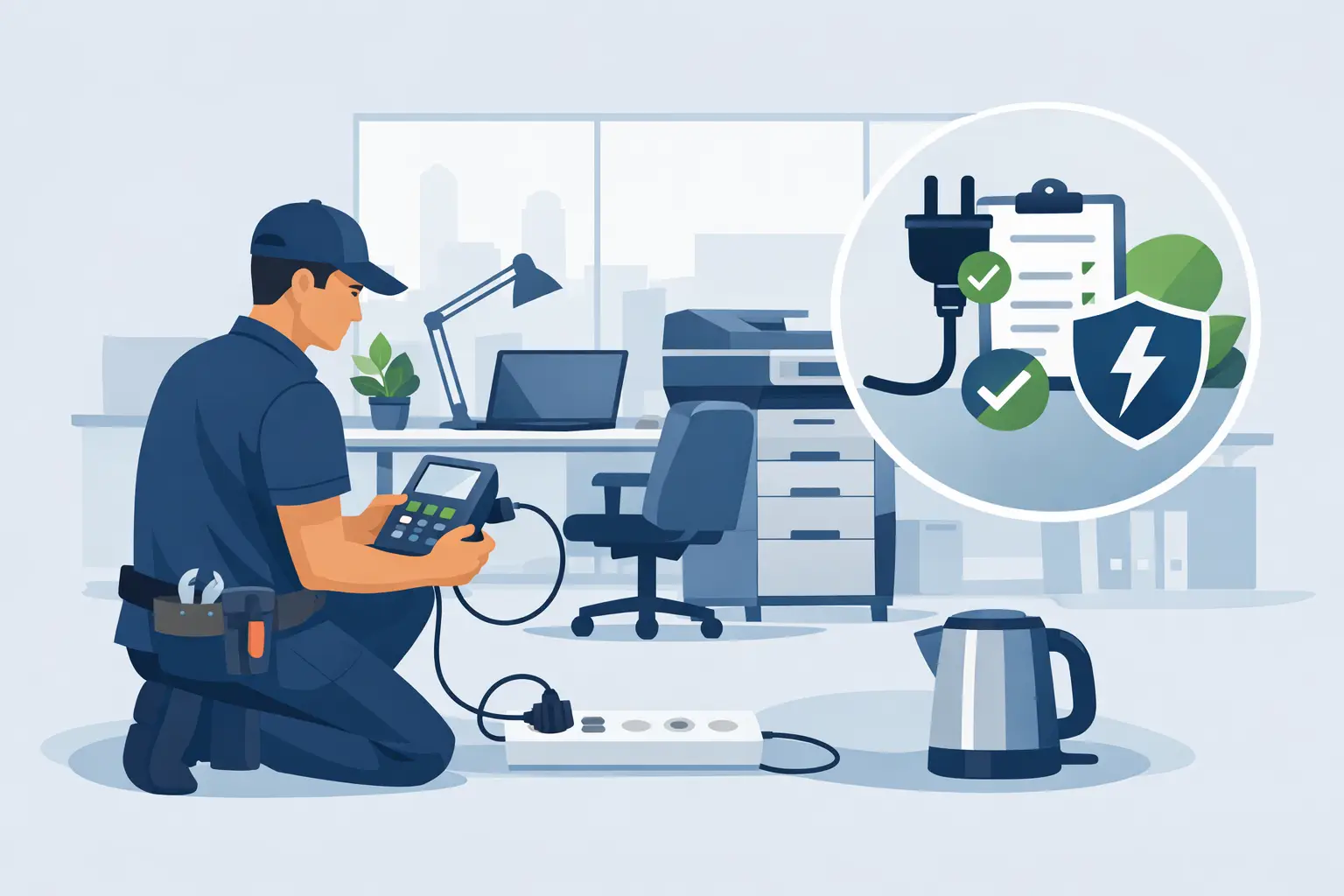
A failed kettle in the staff kitchen rarely looks like a serious safety issue until it trips a circuit, damages a socket, or gives someone a shock. In a busy workplace, small electrical faults are easy to ignore until they disrupt the day or create a real risk. That is why PAT testing for offices matters. It gives employers, office managers and property teams a practical way to keep portable electrical equipment safe, identify problems early, and show they are taking their duty of care seriously.
For most offices, the challenge is not just safety. It is managing dozens, sometimes hundreds, of items across desks, meeting rooms, comms cupboards, kitchens and reception areas without interrupting the working day more than necessary. A sensible PAT testing programme helps you stay organised, reduce avoidable faults and keep your workplace running as it should.
What PAT testing for offices actually covers
PAT stands for Portable Appliance Testing. In simple terms, it is the inspection and testing of electrical appliances that can be moved and connected to the electrical system by a plug. In an office, that usually includes monitors, computers, printers, kettles, microwaves, extension leads, chargers, desk fans and similar equipment.
The key point is that PAT testing is not just about the test instrument itself. A large part of the process is visual inspection. Cracked plugs, damaged cables, loose connections, signs of overheating and unsuitable adaptors are often picked up before any formal electrical test is carried out. In many offices, these visible defects are the most common issues.
This is also where experience matters. A competent electrician will not simply move from item to item applying labels. They should identify patterns, such as overloaded extension blocks under clusters of desks, poorly routed leads in breakout areas, or kitchen appliances that are wearing out faster because of heavy use.
Is PAT testing a legal requirement?
This is where some confusion tends to creep in. There is no single law that says every office must carry out PAT testing at a fixed interval. What the law does require is that electrical equipment is maintained in a safe condition. Employers also have duties under health and safety law to protect staff and others on site.
PAT testing is one of the most practical ways to meet that responsibility. It creates a record, supports risk management and helps show that equipment has been checked by a competent person. For office managers, landlords and business owners, that matters if there is ever an incident, an insurance query or a compliance review.
The right approach depends on the environment. A low-risk office with mostly IT equipment used in clean, dry conditions will not need the same testing frequency as a workshop, warehouse or construction setting. That is why a blanket answer rarely helps. A good contractor will assess the actual risk rather than recommend unnecessary testing just to inflate the job.
Which office items are most likely to fail?
In practice, the highest-risk office appliances are often not the desktop computers. They are the items that get moved, shared, handled frequently or used in kitchen and welfare areas. Kettles, microwaves, portable heaters, extension leads and phone chargers tend to cause more concern than fixed desk equipment.
Extension leads deserve special attention. In many offices, they become a permanent solution rather than a temporary one. Daisy-chaining adaptors, running leads under carpets, or using low-quality multiway extensions can increase both electrical and fire risk. During PAT testing for offices, these items often reveal wider issues with layout, socket provision or workspace planning.
Portable heaters are another common problem. They draw significant load, are sometimes brought in without authorisation and may be used in unsuitable locations. If your office regularly relies on them, it may point to a heating issue that needs addressing at source rather than just repeated appliance checks.
How often should an office have PAT testing?
There is no universal schedule that suits every workplace. Frequency should be based on risk, equipment type and how the office operates. A small professional office with limited equipment and good housekeeping may need less frequent formal testing than a large serviced office with high staff turnover, hot-desking and shared kitchen facilities.
As a rough guide, offices often benefit from regular visual checks in between formal testing visits, with PAT testing arranged annually or at another interval supported by risk assessment. Some items may justify more frequent attention, especially kitchen appliances and heavily used extension leads. Others, such as low-risk IT equipment in stable conditions, may be suitable for longer intervals.
What matters most is consistency and reasoning. If you can show that your testing regime is based on how your office actually functions, you are in a much stronger position than if you are simply following a date in the diary with no clear logic behind it.
What to expect during a PAT testing visit
A professional PAT testing visit should be straightforward and well managed. The process usually begins with identifying which appliances are in scope and confirming access arrangements. In a busy office, this planning stage makes a real difference. It helps avoid wasted time, staff disruption and missed items.
Each appliance is typically inspected visually, tested where appropriate, and labelled or recorded. Faulty items should be clearly identified and removed from use if necessary. At the end, you should receive documentation showing what was tested, what passed, what failed and any recommendations.
For larger sites, clear asset tracking is especially useful. It helps facilities teams understand what equipment is on site, where it is located and whether there are recurring issues in specific areas. That can support budgeting as well as compliance.
The best testing visits are practical, not theatrical. You do not need a contractor who turns a simple compliance task into a major disruption. You need someone who works efficiently, communicates clearly and flags genuine risks without making the process harder than it needs to be.
PAT testing for offices and wider electrical safety
PAT testing is important, but it is only one part of office electrical safety. It does not replace fixed wire testing, proper socket installation, sensible cable management or safe use policies. If your office has persistent tripping circuits, overloaded workstations or ageing distribution equipment, PAT testing alone will not solve the underlying issue.
This is often where businesses benefit from working with a contractor that can do more than one type of test. If problems are found, they can be investigated properly rather than patched over. For example, repeated failures in one area may point to poor socket placement, damaged outlets or a wider issue with the installation itself.
That joined-up approach is especially valuable in leased offices, multi-tenanted buildings and growing businesses where layouts change regularly. Testing the appliance is useful. Understanding why the same types of faults keep appearing is better.
Choosing the right contractor
Office managers and business owners are not usually looking for the cheapest possible label on a plug. They are looking for confidence that the work has been done properly, with minimal disruption and clear records at the end.
A reliable contractor should be able to explain what needs testing, what does not, how often it is sensible to test, and how the work will be carried out around your staff. They should also be honest about the limits of PAT testing. If a workplace needs wider investigation, you should be told that plainly.
For businesses in London and Kent, that often means choosing an electrical contractor with commercial experience, not just someone offering testing as a stand-alone add-on. PG Electrical takes that practical view - keeping offices safe, compliant and operational without overcomplicating the process.
A sensible investment, not a box-ticking exercise
When PAT testing is done properly, it is not just about passing an inspection. It helps reduce downtime, supports staff safety and gives you a clearer picture of the condition of the equipment your business relies on every day.
In an office, electrical safety is easy to take for granted because so much of the risk sits quietly in the background. Regular checks bring that risk back under control. If your workplace has grown, moved, refitted or simply not reviewed its portable appliances for some time, now is a sensible point to put a proper plan in place.