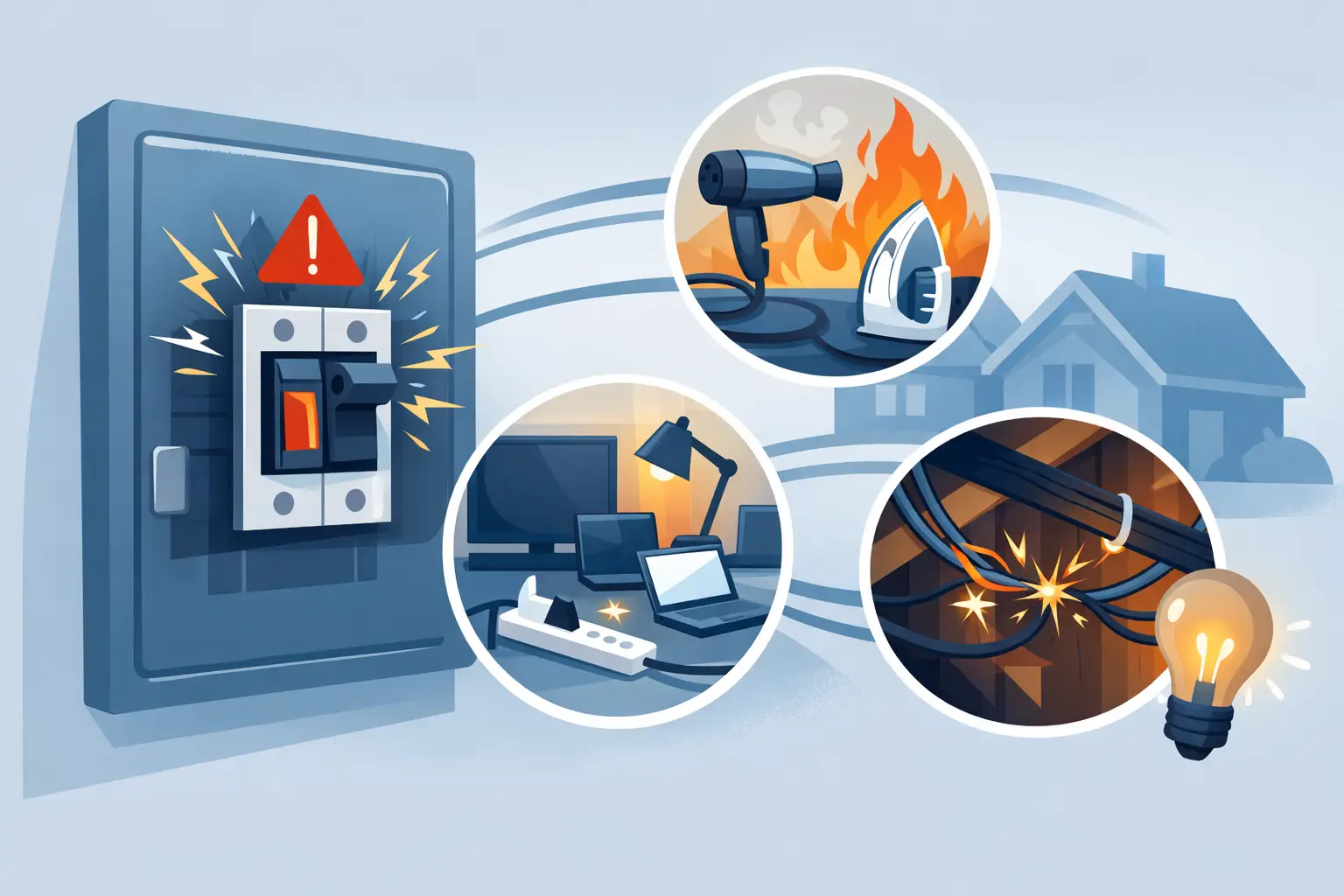
A circuit breaker that trips once while you are using several appliances may be inconvenient. One that trips repeatedly is your electrical installation giving you a clear safety warning. Understanding what causes circuit breaker tripping can help you respond safely, but it should never mean repeatedly resetting a breaker and hoping the problem disappears.
Circuit breakers, RCDs and RCBOs are designed to disconnect the supply before overheating, electric shock or fire can occur. The right next step depends on what has tripped, when it happened and what was running at the time. For homes, rental properties and workplaces, the safest approach is to isolate the issue, avoid guesswork and arrange professional testing where the fault is not obvious.
What causes circuit breaker tripping?
A breaker trips when it detects that a circuit is drawing more current than it is designed to carry, or when a fault creates an unsafe condition. In a modern consumer unit, different protective devices may respond for different reasons.
An MCB, or miniature circuit breaker, generally trips because of an overload or a short circuit. An RCD detects current leaking to earth, which can indicate a shock risk. An RCBO combines both functions and protects an individual circuit. Knowing which switch has moved to the off position gives an electrician a useful starting point, but it does not confirm the fault on its own.
Overloaded circuits
Overloading is one of the most common reasons for a circuit breaker to trip. It happens when too many high-demand items are operating on the same circuit. Kettles, toasters, air fryers, portable heaters, tumble dryers and extension leads can quickly add up, particularly in older properties with limited socket circuits.
The breaker may trip immediately, or it may do so after several minutes as cables and connections warm up. Moving one appliance to another socket does not always solve the issue if both sockets are on the same circuit. A proper assessment may show that the circuit needs to be used differently, that appliances need dedicated supplies, or that the installation requires upgrading.
Short circuits
A short circuit occurs when live and neutral conductors come into contact where they should not. This creates a sudden surge of current, so the MCB will usually trip straight away. Damaged appliance leads, loose connections, crushed cables and faults inside an appliance are all possible causes.
If a breaker trips as soon as you plug in or switch on a particular item, unplug it and leave it out of use. Do not continue trying to reset the breaker with that appliance connected. A damaged lead or appliance should be checked, repaired or replaced before it is used again.
Earth leakage and RCD tripping
RCD and RCBO trips need particular attention because they are intended to reduce the risk of electric shock. Earth leakage can be caused by a deteriorating appliance, damaged cable insulation, a faulty immersion heater, wiring defects or moisture getting into electrical equipment.
A fridge, washing machine or dishwasher can sometimes trip an RCD intermittently as components age or as condensation affects the appliance. That does not make the trip harmless. If the same device repeatedly causes the RCD to operate, it should be isolated and tested. In commercial settings, portable appliances, kitchen equipment and outdoor supplies are frequent areas to investigate.
Moisture and outdoor equipment
Water and electricity are an unsafe combination. External sockets, garden lighting, garage circuits, security lights and equipment near plumbing can trip when moisture reaches a connection or fitting. This can be more noticeable after heavy rain, pressure washing, a leak or a period of high condensation.
Do not open outdoor fittings or attempt to dry internal electrical connections yourself. Turn off the affected circuit if it is safe to do so and arrange inspection. The repair may be as straightforward as replacing a weather-damaged accessory, but the source of water ingress must be addressed as well.
Faulty wiring or loose connections
Older wiring, DIY alterations and poorly executed previous work can all create faults that only become apparent under load. Loose connections generate heat and may cause intermittent tripping, flickering lights, a burning smell or discolouration around sockets and switches.
This is not a fault to monitor casually. If you notice heat, scorching, buzzing, crackling or a burning smell, switch off the relevant circuit where possible and seek urgent electrical help. Do not touch damaged accessories or remove a consumer unit cover.
How to identify the likely cause safely
Start by checking the consumer unit without removing any covers. Look for a breaker, RCD or RCBO that has moved to the off position. Some devices sit in a middle position after tripping and must be moved fully off before they can be reset.
If there are no signs of damage, smoke, overheating or water exposure, switch off and unplug appliances on the affected circuit. Reset the protective device once. If it stays on, reconnect appliances one at a time, allowing a short period between each. When the circuit trips again, the last appliance connected is a strong suspect.
This process is useful for a single, identifiable appliance fault. It is not a substitute for electrical testing. Stop immediately and call a qualified electrician if the breaker will not reset, trips with everything unplugged, trips repeatedly, or affects fixed equipment such as lighting, an electric shower, cooker, boiler or sockets in a bathroom or outside.
For landlords and property managers, record the date, affected circuit, weather conditions and equipment in use when the trip occurred. This information can speed up fault finding and supports a sensible maintenance record. It should not replace the required inspection and testing of the installation.
Why resetting a tripped breaker repeatedly is risky
A circuit breaker is not an inconvenience to override. It is operating because it has detected a condition outside safe limits. Repeated resetting can allow a loose connection to overheat, conceal a developing appliance fault or leave occupants exposed to an earth-leakage issue.
Never replace a breaker with a larger rating to stop it tripping. Cable sizes, installation methods and circuit design determine the correct protective device. Fitting an incorrectly rated breaker can remove the protection the cable needs and significantly increase fire risk.
Avoid relying on extension leads as a permanent answer to a shortage of sockets. They are useful for temporary, low-load use, but daisy-chaining extension leads or running high-power appliances through them creates avoidable risks. A qualified electrician can advise whether additional sockets, a new circuit or a consumer unit upgrade is the better long-term solution.
When a professional inspection is needed
A one-off trip caused by an overloaded kitchen circuit may have a simple explanation. Regular tripping, however, deserves investigation, especially in older homes, HMOs, offices, shops and premises with changing electrical demands.
An electrician can carry out targeted fault finding using suitable test equipment, rather than relying on trial and error. This may include insulation resistance testing, earth fault loop impedance testing, RCD testing and checks of fixed wiring, accessories and connected equipment. The work should identify the cause and confirm that the repair has restored safe operation.
For a rental property, recurring trips may also point to wider concerns that an Electrical Installation Condition Report can identify. For businesses, an unexpected trip can interrupt trading, affect IT systems or compromise emergency systems, so prompt diagnosis is particularly valuable.
PG Electrical provides practical fault finding and electrical testing for homes, landlords and businesses across Greater London and Kent. Where a fault requires urgent attention, a clear diagnosis and safe repair are more valuable than a temporary reset.
A tripping breaker is doing its job. Treat it as an early warning, isolate anything you suspect, and get professional support before a minor interruption develops into a more serious electrical problem.