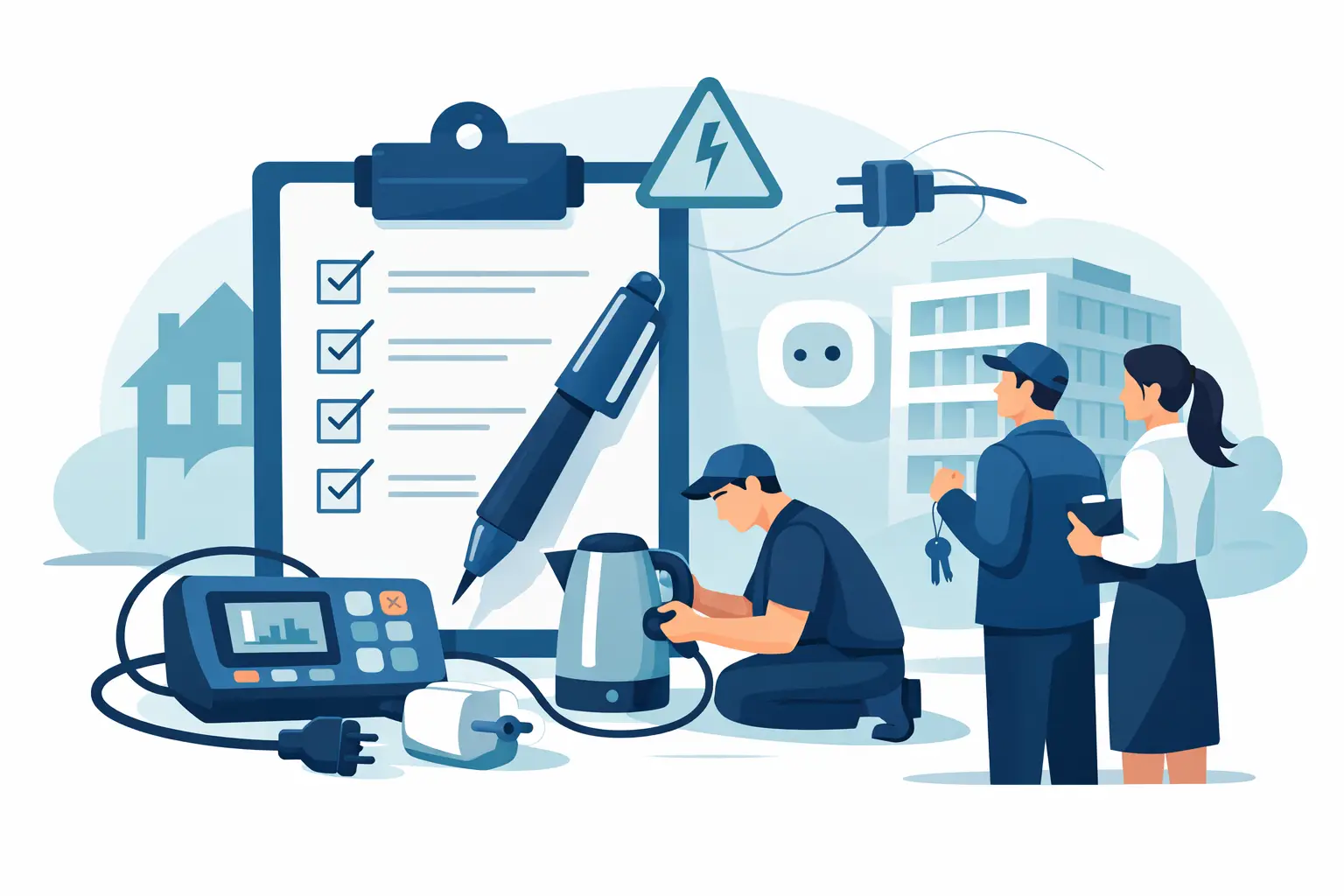
A PAT testing checklist is most useful before an appliance causes disruption, injury or a failed inspection. For landlords, managing agents and business owners, it provides a clear way to identify what needs checking, decide how often it should be inspected and keep evidence that electrical equipment is being managed responsibly.
PAT testing, or portable appliance testing, is not simply a sticker applied to every item with a plug. It is a proportionate process of visual inspection, electrical testing where appropriate and accurate record keeping. The right approach depends on the equipment, who uses it and the environment it operates in.
What should a PAT testing checklist achieve?
Your checklist should give you a complete and current picture of portable electrical equipment at the property or workplace. That includes equipment owned by the business or landlord, as well as items supplied for staff, tenants, contractors or communal areas.
A good checklist helps you spot damaged equipment early, plan testing without interrupting normal operations and demonstrate a sensible approach to electrical safety. It should also make clear who is responsible for removing faulty items from service and arranging repairs or replacements.
For most premises, the process begins with an asset register rather than a tester. Walk through each room, office, workshop, communal area and store cupboard. Record the item, its location, make or model where available, and a unique asset number. This avoids common gaps, such as forgotten extension leads, chargers and equipment stored for occasional use.
PAT testing checklist: equipment to include
Portable equipment is generally any electrical item that can be moved while connected to the supply, or that has a flexible lead and plug. Some fixed equipment can also need attention where a plug and lead form part of its connection.
Your register should cover the following categories where they are present:
- Computers, monitors, printers, scanners, phones, chargers and docking stations.
- Kitchen equipment such as kettles, microwaves, toasters, coffee machines and fridges.
- Cleaning equipment, including vacuum cleaners, carpet cleaners and floor polishers.
- Hand-held tools, battery chargers, site equipment and portable lighting.
- Extension leads, multiway adaptors, trailing sockets and cable reels.
- Tenant or staff appliances that are permitted for use in a managed workplace or communal accommodation.
Do not overlook low-cost items. A damaged phone charger or overloaded multiway adaptor can create as much concern as a larger appliance, particularly in offices, HMOs and shared staff areas. Equipment brought in by employees or contractors should be managed under a clear site policy. Whether you test it, prohibit it or require proof of inspection will depend on the risks and the nature of the premises.
Check the plug, lead and casing first
A formal visual inspection is often the most valuable part of PAT testing. Many faults are visible before any test instrument is used. Check that the plug is undamaged and correctly assembled, with no cracks, loose pins or signs of overheating. The cable should not be frayed, trapped, twisted excessively or repaired with tape.
Look closely at the appliance casing, controls and cable entry point. Cracks, exposed live parts, scorch marks, loose covers and damaged strain relief all require action. Confirm that the correct fuse is fitted in a UK plug, where applicable, and that extension leads and adaptors are being used safely rather than daisy-chained together.
If an item fails a visual check, remove it from use immediately. Label it clearly, record the defect and arrange repair, replacement or disposal. Passing an electrical test does not make visibly damaged equipment safe.
Identify the appliance class and testing needs
The appliance type affects which tests may be appropriate. Class I equipment relies on an earth connection for protection and commonly includes metal-bodied appliances, many kettles, desktop computers and some power tools. Class II equipment is double insulated, normally marked with a square within a square, and does not rely on an earth connection in the same way.
There are also leads, chargers, IT equipment and appliances with electronic controls that need suitable testing methods. A competent tester will select the right test rather than applying a single procedure to every item. An insulation resistance test, for example, may not be suitable for sensitive electronic equipment without the correct precautions.
This is why a simple pass or fail label should not be your only record. Your documentation should identify the equipment and the checks completed, as well as any limitations, repairs or advisory observations.
Set testing intervals based on risk
There is no universal legal rule requiring every portable appliance to be tested annually. The Electricity at Work Regulations require electrical systems to be maintained so far as reasonably practicable to prevent danger. In practice, this means inspection and testing intervals should reflect risk rather than an arbitrary date on a label.
A busy construction environment, commercial kitchen or workshop normally needs more frequent checks than a low-risk office with well-maintained IT equipment. Appliances handled regularly, used outdoors, moved between sites or exposed to heat, moisture and dust deserve closer attention. Equipment in communal residential areas may also require a more structured programme because it is used by multiple people.
For a typical office, routine user checks and periodic visual inspections may be sufficient for some lower-risk items, while extension leads and frequently moved equipment may need testing more often. For a rental property, the approach should be considered alongside wider landlord electrical safety duties, including the condition of fixed wiring and the need for an EICR. PAT testing does not replace an Electrical Installation Condition Report.
Review intervals after an incident, refurbishment, water ingress, a change in use or repeated equipment failures. A risk-based programme should evolve with the premises rather than remain unchanged year after year.
Keep records that stand up to scrutiny
A labelled appliance is helpful, but the test record is what gives the label meaning. Keep an asset register showing the equipment description, unique ID, location, appliance class, inspection date, test result, tester details and next review date. Where equipment fails, record the fault, the action taken and when it was returned to service, if repaired.
Clear records make property management easier. They allow you to see whether a recurring problem is linked to a particular area, appliance type or user practice. They also help when a business moves premises, a landlord changes managing agent or a client asks for evidence of safety controls.
Make sure old equipment is removed from the register when disposed of, and new equipment is added promptly. An outdated list creates false confidence and can leave gaps in your testing programme.
Prepare the site before testing
Testing is quicker and less disruptive when equipment is accessible and staff know what to expect. Ask occupiers to save work and shut down computers where necessary. Identify essential equipment that cannot be disconnected during business hours, such as servers, medical equipment, alarms or refrigeration, so testing can be planned around operational needs.
Do not allow a testing schedule to compromise business continuity or safety systems. Some equipment needs specialist consideration, and fixed installations, emergency lighting and fire alarm systems have their own inspection and maintenance requirements.
A competent electrician will agree the scope, identify exclusions and explain any items that need separate assessment. This is particularly valuable in mixed-use buildings, occupied rental properties and sites with a combination of office, retail and light industrial areas.
Who should carry out PAT testing?
Routine user checks can be completed by people who have been given clear instructions, such as reporting damaged leads or loose plugs. Formal inspections and electrical testing should be carried out by someone competent to do the work, with suitable equipment and an understanding of the appliances being assessed.
Competence is more than owning a PAT tester. The person carrying out the work should be able to recognise defects, select appropriate tests, interpret results and know when an appliance should be removed from service. They should also provide records that are clear enough for a landlord, facilities manager or business owner to act on.
For larger portfolios or busy commercial premises, it is worth coordinating PAT testing with other electrical maintenance. Combining planned visits can reduce disruption and give you a more complete view of the property’s electrical condition.
PG Electrical provides practical PAT testing support for homes, rental properties and commercial premises across Greater London and Kent. The focus should always be on safe equipment, sensible testing intervals and records you can rely on, not testing for testing’s sake.
Start with an accurate equipment list, deal with visible damage without delay and review your programme whenever the risks at the property change. That small amount of control can prevent an avoidable fault becoming a much bigger problem.