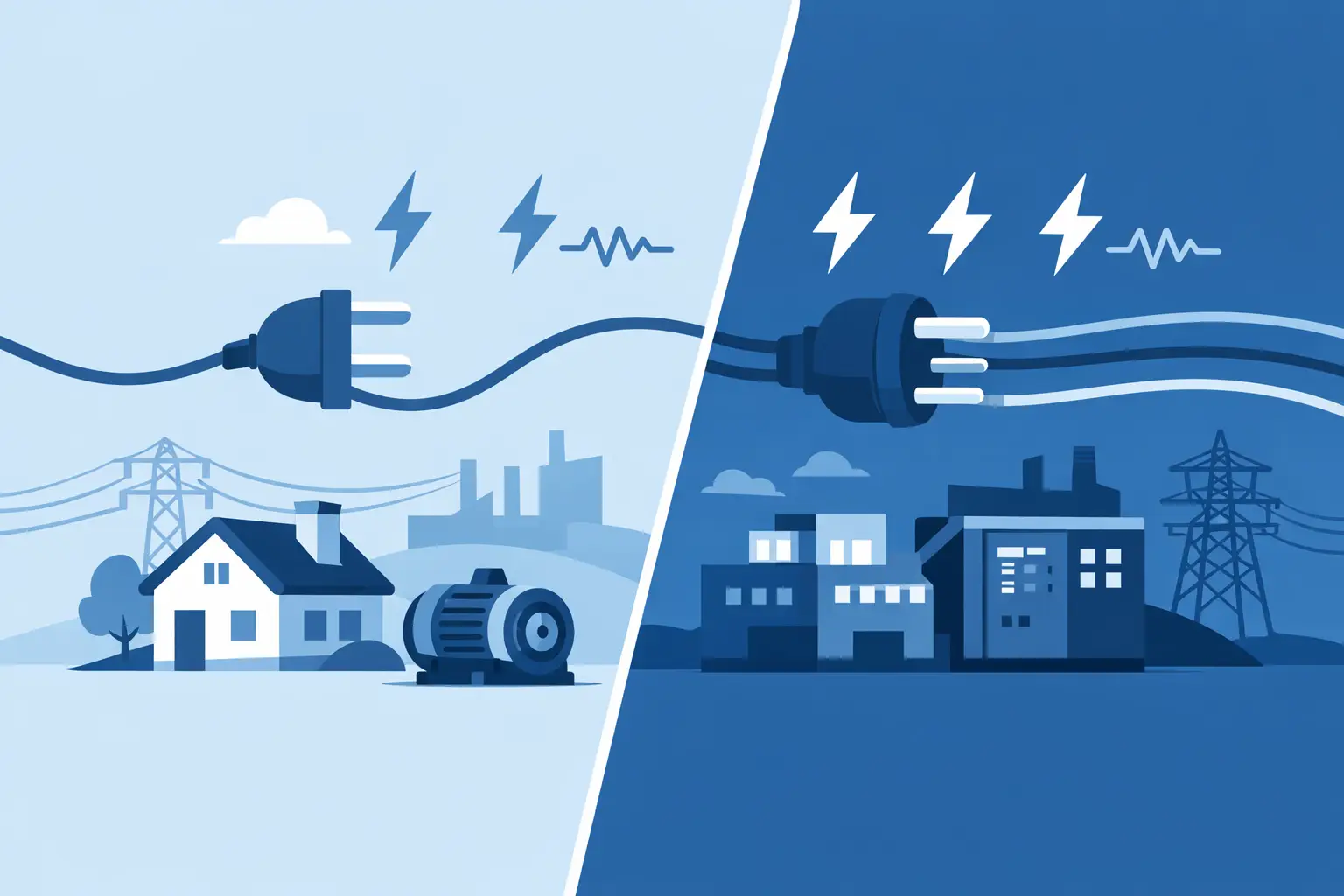
A new EV charger, electric heating system or workshop machine can expose a limitation that has gone unnoticed for years: the incoming electrical supply. When comparing single phase vs three phase, the right answer is not simply that three phase is better. It depends on the total load, how that load is used, the property’s future plans and the capacity available from the local network.
For homeowners, landlords and business owners, getting this decision right helps prevent overloaded circuits, disruptive upgrades and costly redesigns later. It also ensures any installation is planned around safety, performance and compliance from the outset.
What is single-phase electricity?
Single-phase electricity is the most common type of supply for UK homes, flats and smaller premises. It delivers power through one live conductor and one neutral, with an earth conductor for protection. In a typical property, the supply is approximately 230V.
Most everyday equipment is designed to run perfectly well on single phase. That includes lighting, sockets, ovens, washing machines, boilers, home office equipment and many domestic EV chargers. A consumer unit distributes this incoming supply safely across separate circuits, each protected by the appropriate device.
The practical limitation is capacity. A standard single-phase supply is often rated at 60A, 80A or 100A, although the actual rating must be confirmed rather than assumed. A 100A supply can provide a substantial amount of power, but high-demand equipment used at the same time can quickly use up the available headroom.
For example, an electric shower, induction hob, oven, heat pump and 7kW EV charger may all be suitable for a single-phase home individually. If several operate together, however, the maximum demand needs careful calculation. Good design is about more than adding up appliance ratings. An electrician considers diversity - the realistic likelihood of every load running at full output at once - alongside the property’s use and future requirements.
What is three-phase electricity?
Three-phase electricity uses three live conductors, each carrying an alternating current offset from the others, plus neutral and earth where required. In the UK, the voltage between any phase and neutral is approximately 230V, while the voltage between phases is approximately 400V.
This arrangement can deliver much more power and is particularly useful where loads are larger, continuous or motor-driven. It is common in shops, offices, warehouses, restaurants, communal buildings and light industrial units. It is also found in some larger homes and new developments, especially where there is a need for high-capacity EV charging or all-electric heating.
A three-phase supply does not mean every circuit or appliance must use 400V. Standard single-phase circuits can still be installed, with loads spread across the three phases. This is often valuable in commercial premises because it allows lighting, socket circuits, kitchen equipment and other services to be balanced rather than concentrated on one supply.
Three-phase equipment can include larger air conditioning systems, commercial catering equipment, lifts, pumps, compressors, machine tools and high-output EV charging equipment. The exact requirement will be stated on the equipment specification and should be checked before a purchase is made.
Single phase vs three phase: the key differences
The clearest difference between single phase vs three phase is the amount and distribution of available power. Single phase is straightforward and economical for typical domestic demand. Three phase provides greater capacity and can support larger loads with better balance across the installation.
Three phase is also well suited to motors. A three-phase motor generally runs more smoothly and efficiently than an equivalent single-phase motor, which matters for equipment that starts and runs frequently, such as ventilation systems, pumps and workshop machinery.
That said, a three-phase supply is not automatically the best choice for a small home or modest retail unit. The installation may require a different consumer unit or distribution board, new cabling, careful phase balancing and coordination with the Distribution Network Operator (DNO). Where the existing supply and demand are appropriate, a well-designed single-phase installation remains the sensible option.
The cost comparison is equally dependent on the property. A three-phase upgrade can involve network works beyond the boundary of the building, and those costs, lead times and feasibility vary by location. The internal electrical work is only one part of the project.
When is single phase likely to be enough?
Single phase is usually suitable for conventional homes, flats, small rental properties and many small offices. It can support a comprehensive modern installation when circuits are correctly designed and the incoming supply is adequate.
A homeowner fitting a 7kW EV charger, for example, will commonly use single phase. If capacity is tight, load management may be a practical solution. This allows the charger to reduce output temporarily when the property’s overall demand is high, helping to avoid overloading the supply without compromising safety.
For landlords, the priority is often the condition and safety of the existing installation rather than converting the supply type. An Electrical Installation Condition Report (EICR) can identify issues such as an undersized consumer unit, deteriorated wiring, inadequate earthing or circuits that no longer suit the property’s use. These faults should be addressed before considering major new loads.
Signs that three phase may be worth considering
Three phase becomes a serious consideration when the demand is consistently high, when large equipment is planned, or when a property is being redesigned for a more intensive use. A commercial kitchen, a building with several EV charge points, a workshop adding machinery or a large all-electric refurbishment are common examples.
It can also make sense where a site has repeated nuisance tripping or evidence that the existing supply is operating close to its limit. Tripping does not always mean the supply itself is too small - it can be caused by a faulty appliance, circuit fault or incorrectly selected protective device. A proper assessment should establish the cause before an upgrade is specified.
Developers should consider three phase early in the design process. Waiting until finishes are complete can make routes for submains, containment, distribution boards and metering far more difficult and expensive. Early planning also gives time to discuss the connection arrangement with the DNO and confirm whether the desired capacity is available.
EV charging: a common reason for the question
EV charging is one of the most frequent reasons people ask about supply type. A standard domestic single-phase charger is usually rated up to 7.4kW. This is a practical overnight charging solution for many households and does not, by itself, require three phase.
Three phase allows higher charging rates where the vehicle, charger and supply are compatible. An 11kW or 22kW charger may be appropriate for commercial sites, fleet vehicles or premises where vehicles need to return to service quickly. However, faster charging is only useful if the vehicle can accept that rate and the building has sufficient capacity after other essential loads are allowed for.
The charger should never be selected in isolation. Cable routes, earthing arrangements, protective devices, load balancing and the building’s maximum demand all need to be assessed. In some cases, intelligent load management offers a better value outcome than a supply upgrade.
What an electrical assessment should cover
Before choosing between supply types, a competent electrician should inspect the existing intake equipment and understand how the property operates. This includes the service fuse rating, meter position, consumer unit or distribution board, earthing and bonding, main cable sizes and the condition of the installation.
The assessment should also look forward. Planned extensions, electric heating, air conditioning, commercial equipment, additional rental units and EV charging can all change the answer. A clear load schedule and maximum-demand calculation give the project a sound basis, rather than relying on assumptions or sales claims.
If a three-phase connection is required, the DNO controls the network-side work. An electrical contractor can prepare the installation, advise on the specification and coordinate the technical requirements, but cannot alter the network supply without the DNO’s approval.
Choose capacity for the way the property will be used
The right electrical supply should support the property safely today while leaving sensible room for tomorrow. For many homes, single phase remains entirely capable. For high-demand commercial premises, multi-unit buildings and projects with significant electric loads, three phase can provide the capacity and flexibility needed for reliable operation.
The most useful next step is not to guess from the size of the building. Have the existing installation and planned loads assessed before equipment is ordered. PG Electrical can help identify a practical, compliant route that fits the property, the budget and the way power will actually be used.