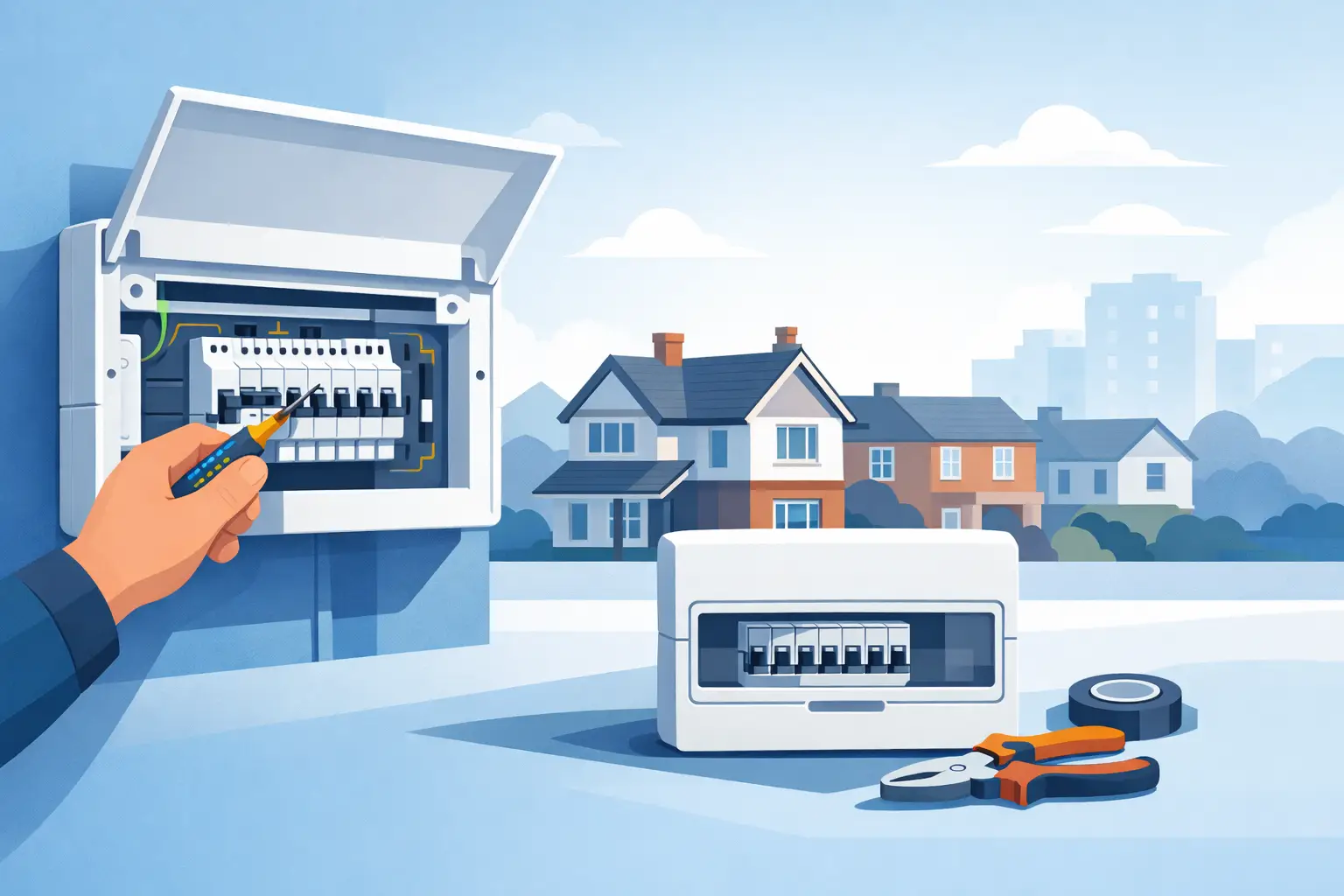
A consumer unit is easy to ignore until a circuit starts tripping, a fuse board looks dated, or an EICR raises concerns. This consumer unit replacement guide explains when an upgrade is sensible, what the work involves and how to plan it safely for a home, rental property or business premises.
The consumer unit - often called a fuse board or fuse box - is the point from which electricity is safely distributed around a property. It protects individual circuits for lighting, sockets, appliances and fixed equipment. A modern unit is not simply a tidier version of an old board. It provides a much higher level of protection against electric shock, overloads and certain fault conditions.
When should a consumer unit be replaced?
Age alone does not automatically mean a consumer unit is unsafe. Some older installations can remain serviceable if they have been properly maintained and tested. However, an older fuse board may not meet the safety expectations of a modern property, especially where new circuits, electric heating, an EV charger, an extension or a kitchen refurbishment have changed the electrical demand.
Replacement is commonly recommended where an inspection identifies safety concerns, damage, inadequate protection or poor previous work. It can also be the practical route when a property needs additional circuits and there is no safe, compliant space to extend the existing board.
The following signs warrant an assessment by a qualified electrician:
- Rewireable fuses or an old-style fuse board with no RCD protection.
- Repeated tripping that cannot be traced to one appliance or circuit.
- Heat marks, a burning smell, buzzing, loose components or a cracked enclosure.
- A failed or unsatisfactory EICR, particularly one recording potentially dangerous observations.
- Major renovation work, a rewire, a new electric shower, induction hob, air conditioning system or EV charger.
Tripping does not always mean the consumer unit itself has failed. A faulty appliance, damaged cable, moisture ingress or an overloaded circuit may be the cause. That is why diagnosis comes before replacement. Changing the board without identifying underlying faults can leave the real problem in place.
Consumer unit replacement guide: start with an assessment
A proper replacement begins with the condition of the existing installation, not with choosing a board from a catalogue. Before fitting a new consumer unit, an electrician should inspect the installation and carry out appropriate testing to establish whether the circuits, earthing and bonding arrangements are suitable.
This matters because a new unit may provide more sensitive protection than an old one. If cables are damaged, connections are loose or insulation resistance is poor, the new protective devices may trip immediately. That is not a fault with the new board - it is evidence that the installation needs further attention.
The assessment should consider the incoming supply, main earthing conductor, gas and water bonding where applicable, circuit condition, current loading and the property’s likely future needs. For commercial sites, it should also account for equipment such as emergency lighting, fire alarms, server equipment, roller shutters, three-phase machinery or landlord supplies.
You should receive a clear explanation of the findings and a detailed quotation. If remedial work is needed before or alongside the replacement, it should be itemised rather than hidden within a vague allowance.
What a compliant replacement involves
Consumer unit replacement is not a like-for-like cosmetic job. It requires careful isolation, safe working procedures, installation, full testing and certification. In England and Wales, work of this nature is generally notifiable under Part P of the Building Regulations. A registered electrician can arrange notification through the relevant competent person scheme where required.
A typical installation includes a metal consumer unit, correctly rated protective devices, RCD or RCBO protection, clear circuit labelling and suitable cable entries. Modern units may also include surge protection devices, known as SPDs, which help protect sensitive electronic equipment from transient overvoltages.
RCBOs are often a strong option because each circuit has individual fault protection. If one circuit develops a fault, only that circuit should disconnect, rather than taking out several circuits together. This can be particularly useful in larger homes, HMOs, offices and premises where loss of lighting, refrigeration or IT equipment would cause unnecessary disruption.
There are trade-offs. A higher-specification unit can cost more initially, but it may offer better fault discrimination, easier fault finding and more flexibility for future additions. The right design depends on the property, its electrical load and the condition of the existing installation.
Once the work is complete, the electrician should test the installation and provide an Electrical Installation Certificate. You should also receive test results, circuit schedules and building regulations compliance documentation where applicable. Keep these documents with property records. They are useful for future electrical work, property sales, insurance queries and landlord compliance.
Choosing the right protection for your property
The best consumer unit is not necessarily the largest or most expensive one. It needs to be correctly designed for the supply and the circuits it serves. A small flat with modest electrical demand will have different requirements from a converted house with an electric shower, home office, heat pump and EV charging point.
Surge protection is increasingly worth considering because many properties now rely on televisions, boilers, routers, smart controls, appliances and work equipment containing sensitive electronics. It may be required or recommended depending on the installation design and risk assessment.
Arc fault detection devices, or AFDDs, provide an additional layer of protection against certain arcing faults. They are particularly relevant in higher-risk settings, sleeping accommodation and some commercial environments. They are not a universal answer for every property, so a competent electrician should explain whether they are appropriate for the installation rather than adding them without discussion.
Allow capacity for the future where practical. Spare ways can avoid the need for another board when adding an EV charger, garden office, loft conversion, electric heating or upgraded kitchen circuits. Space is valuable, but so is sound design: unused capacity should never be used as a substitute for checking supply capacity and cable sizes.
Cost, disruption and preparing for the work
The cost of a consumer unit replacement varies because the board is only one part of the job. The number of circuits, type of protective devices, access, earthing upgrades, repairs identified during testing and any additional circuits all affect the final price. A transparent quotation should make clear what is included, any assumptions and the likely cost of foreseeable remedial work.
Expect a planned power shutdown while the old unit is removed, the new one is installed and the circuits are tested. The duration depends on the property and the condition of the installation. An electrician should confirm arrangements for alarms, refrigeration, medical equipment, electric gates, internet equipment and business-critical systems before work begins.
Clear access to the consumer unit and nearby sockets helps the work proceed efficiently. If the board is in a cupboard, remove stored items in advance. For landlords and property managers, arranging access to communal areas, tenant supplies and meter rooms early can prevent delays.
Landlords, HMOs and commercial premises
For landlords, an EICR is the best starting point where the condition of the installation is uncertain. An unsatisfactory report does not always mean a full consumer unit replacement is required, but it may identify missing RCD protection, damaged components or other issues that make replacement the sensible route.
HMOs and commercial properties need extra care. Circuit separation, emergency systems, shared supplies, fire safety equipment and continuity of operations can all influence the design. Work may need to be phased to minimise disruption, particularly in occupied buildings, offices, shops or light industrial units.
A professional contractor should manage the process from inspection and quotation through installation, testing and certification. PG Electrical provides this practical end-to-end approach across Greater London and Kent, with clear communication at every stage.
Questions property owners often ask
Can I replace a consumer unit myself?
No. This is safety-critical work that requires electrical design, testing and certification. Incorrect installation can create shock and fire risks, invalidate insurance and leave building regulations requirements unmet.
Will a new consumer unit stop all tripping?
Not necessarily. A correctly installed modern board will identify faults more effectively, but it cannot repair a faulty appliance, damaged cable or moisture problem. Investigation and testing are essential when circuits trip repeatedly.
Does a new consumer unit mean the whole property needs rewiring?
No. If testing shows the existing circuits are in satisfactory condition, a full rewire may not be necessary. Where circuits are deteriorated, incorrectly installed or unsuitable for modern use, targeted repairs or rewiring may be recommended.
A well-planned consumer unit upgrade is an investment in safer day-to-day use, not just a box on the wall. Arrange an assessment before problems become urgent, and make sure the finished installation is tested, documented and ready for the way you use the property.