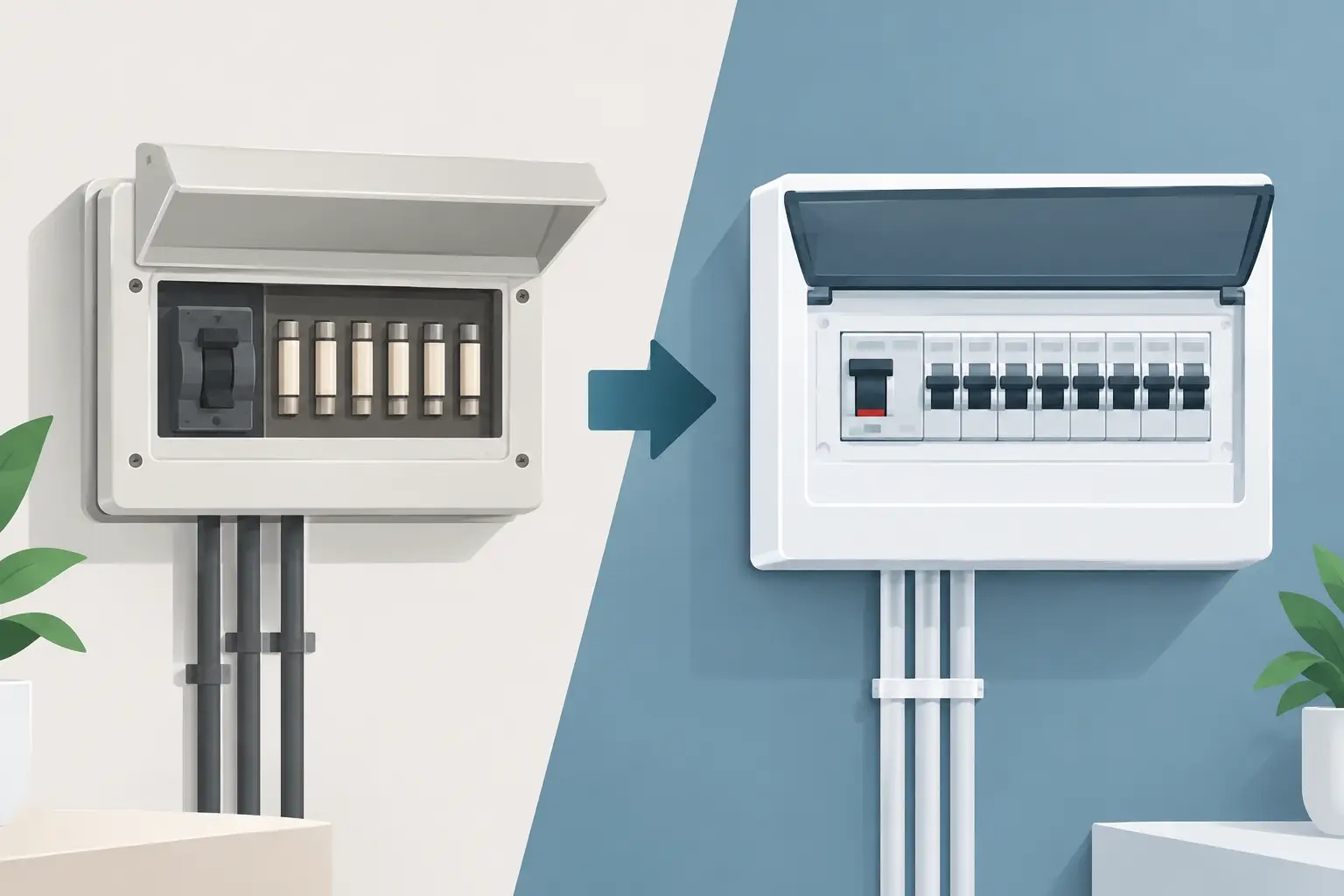
A fuse board versus consumer unit comparison is not simply a question of old terminology versus new. It is about how your property protects people, circuits and appliances when a fault occurs. If you have an older board with wire fuses, a consumer unit upgrade may offer considerably better protection. However, the condition of the wiring, the property’s use and the results of electrical testing matter just as much as the board itself.
For homeowners, landlords and business owners, the right decision starts with a professional assessment rather than a visual judgement. An older installation is not automatically unsafe, and a new consumer unit cannot make damaged or unsuitable wiring safe on its own.
Fuse board versus consumer unit: the key difference
A fuse board is the older name commonly used for the electrical distribution board that divides your incoming electricity supply into separate circuits. These might include lighting, socket outlets, a cooker, shower, boiler or outbuilding. Traditional fuse boards often use rewirable fuses, which contain a length of fuse wire designed to melt when excessive current passes through it. Some later boards use cartridge fuses.
A consumer unit performs the same core job but normally uses modern protective devices. Instead of replacing fuse wire after a fault, a miniature circuit breaker, known as an MCB, switches off or trips. Once the cause is found and made safe, it can usually be reset.
Modern consumer units can also include residual current devices, or RCDs, and residual current circuit breakers with overcurrent protection, known as RCBOs. These detect certain electrical faults that may not draw enough current to operate a standard fuse or MCB. That additional protection is particularly valuable for socket circuits, circuits supplying equipment outdoors and areas where water is present.
The practical difference is speed, selectivity and safety. A well-designed consumer unit can isolate only the circuit with the fault, rather than taking out half the property. This is useful in a home, but it can be critical in a rental property, office or commercial premises where lost lighting, refrigeration, IT equipment or safety systems can cause disruption.
Why older fuse boards can become a concern
A rewirable fuse board may have given reliable service for many years. The concern is that it may not meet the level of protection expected from a modern installation, particularly where circuits have been altered, extended or put under greater demand.
A common issue is that a fuse wire has been replaced with the wrong rating. Using thicker wire than intended can stop a fuse operating soon enough during a fault, leaving cables at risk of overheating. Fuse carriers can also deteriorate, connections can loosen and older boards may have limited capacity for new circuits.
Many older boards do not provide RCD protection. This does not mean every property with an old fuse board is immediately dangerous, but it does mean the installation should be assessed carefully. An Electrical Installation Condition Report, or EICR, identifies observed damage, deterioration, defects and departures from current safety standards. It gives you evidence on which to base a decision, rather than relying on assumptions.
Age alone is not a diagnosis. A professionally installed and well-maintained older board may be in better condition than a poorly altered newer one. Equally, a smart-looking consumer unit can hide problems in the wiring beyond it.
What a modern consumer unit can provide
The best consumer unit arrangement depends on the property and its circuits. For many domestic installations, RCBO protection on individual circuits is a strong option because a fault on one circuit is less likely to interrupt others. For example, a fault on an outdoor socket circuit need not switch off upstairs lighting or the fridge.
A modern unit may include a main switch, MCBs or RCBOs, RCD protection and surge protection where required or appropriate following assessment. Surge protective devices can help reduce the impact of transient voltage spikes on sensitive electronics, from televisions and routers to heating controls and business equipment.
The enclosure is also relevant. Modern domestic consumer units are typically metal-clad, offering improved fire containment compared with many older plastic units. The unit must still be correctly selected, installed and tested. Safety does not come from the box alone.
For larger homes, HMOs, offices and light industrial sites, the solution may be more involved. Existing distribution boards, submains, three-phase supplies, emergency lighting and fire alarm circuits all need to be considered. In these settings, maintaining continuity for essential services can be as important as adding protection.
When replacement is usually worth considering
Replacement is often sensible where a fuse board has no RCD protection, shows signs of heat damage or deterioration, has obsolete components, lacks spare capacity, or is being altered to support major electrical work. A full rewire, kitchen extension, loft conversion, electric shower, heat pump or EV charger can all change the demands placed on an installation.
Landlords should be especially careful. Rental properties require periodic electrical safety checks, and an unsatisfactory EICR may identify remedial work that needs attention. A consumer unit replacement is sometimes part of that remedial work, but it should be recommended because it addresses identified risks or supports the necessary design, not as a one-size-fits-all answer.
If circuits are regularly tripping, do not assume the board is at fault. The cause could be a defective appliance, moisture ingress, damaged cable, overloaded circuit or a fault in fixed wiring. Repeatedly resetting a protective device without investigation can be unsafe. A qualified electrician should trace the fault and explain the remedy clearly.
A consumer unit upgrade is not a quick swap
Replacing a consumer unit is a significant electrical job. It involves working at the point where all final circuits are connected, and it may reveal faults that were previously hidden because the old board offered less sensitive protection.
Before work starts, an electrician should inspect the installation and assess the earthing and bonding arrangements, condition of the cables, circuit identification, load requirements and location of the proposed unit. In some properties, cables may need repairs or testing may identify circuits that cannot safely be connected to a new RCD- or RCBO-protected board without remedial work.
During installation, each circuit should be identified, connected to correctly rated protective devices and tested. On completion, you should receive the appropriate electrical installation certification and test results. Where building regulations notification applies, this should also be handled correctly.
This process is why transparent quotations matter. A proper quotation should explain what is included, what assumptions have been made and what may require additional work if uncovered during testing. The cheapest replacement quote is not necessarily the best value if it excludes essential inspection, certification or remedial work.
Choosing the right arrangement for your property
There is no single consumer unit specification that suits every building. A straightforward flat with a small number of circuits has different needs from a family house with an EV charger, garden office and electric heating. A commercial unit may require separate boards, controlled isolation and dedicated protection for safety-critical equipment.
Location also matters. A consumer unit needs to be accessible for safe operation and maintenance, but it should not be placed where it is exposed to avoidable damage, damp or excessive heat. Labels should be clear enough for occupants, tenants and facilities teams to isolate a circuit in an emergency.
For landlords and property managers, plan for the way the property is actually used. Communal areas, smoke alarms, emergency lighting, electric gates, outbuildings and tenant-installed appliances can all affect the design. For homeowners, future plans such as an extension, solar PV, battery storage or EV charging are worth raising before the work is specified.
PG Electrical approaches consumer unit work as part of the wider installation, not an isolated replacement. That means checking what the existing system can safely support, explaining the options in plain terms and completing the testing and certification needed for confidence after the work is finished.
A fuse board does not need replacing solely because it is old, but it should never be ignored because it is familiar. If you are unsure about the protection in place, have tripping circuits, are planning electrical upgrades or need evidence for a rental property, arrange a professional inspection first. The right outcome is a system that is safe, properly tested and suited to the way your property operates.