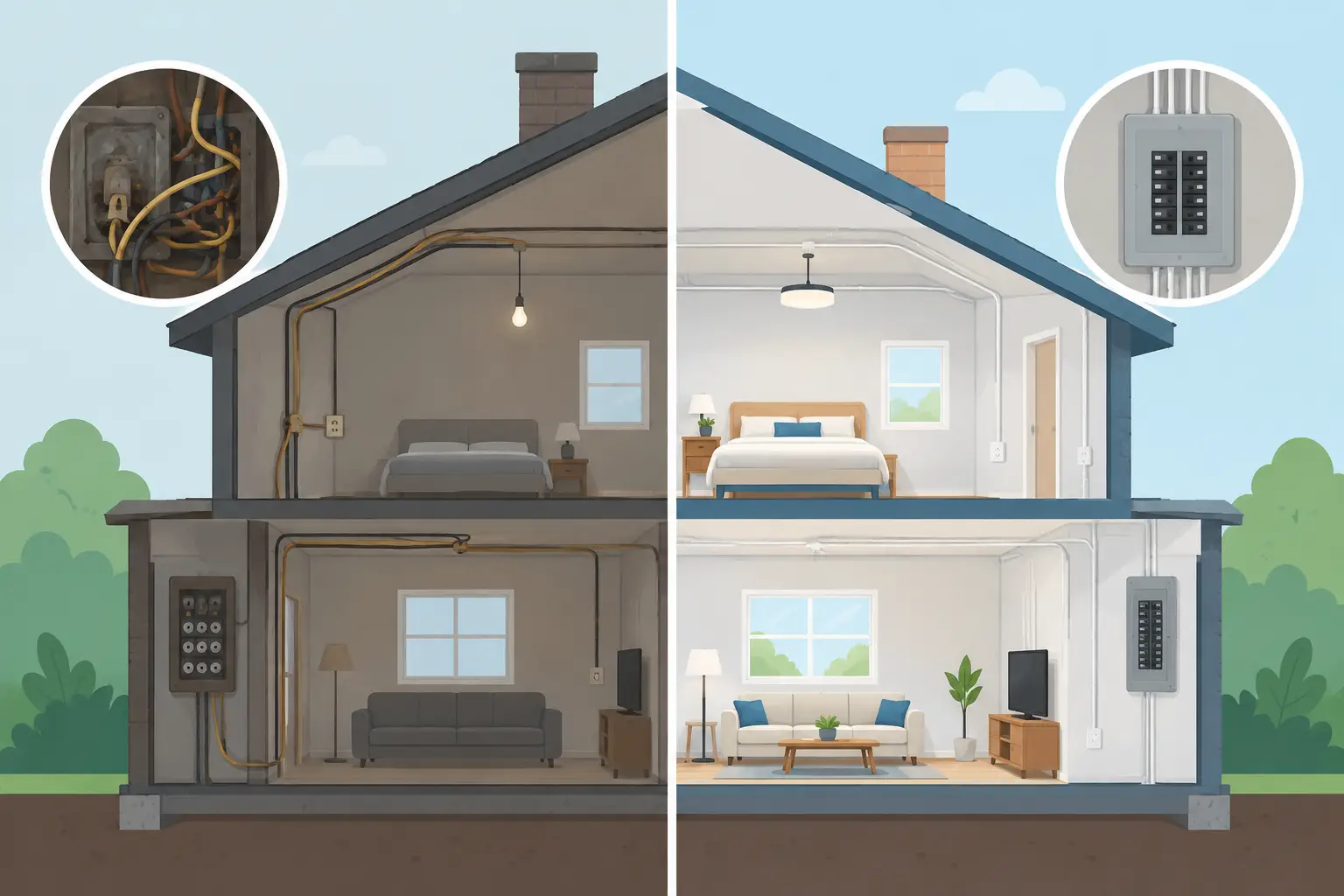
A house rewire before and after comparison can be striking, but the biggest improvement is usually hidden behind the walls. Old, overloaded or deteriorating cables are replaced with a safer electrical installation designed for how the property is used now. That means reliable sockets where they are needed, properly protected circuits, modern lighting and a clear record that the work has been tested.
For homeowners, landlords and property managers, a rewire is a significant project. It creates disruption, requires planning and often involves making good walls and ceilings afterwards. Done properly, however, it removes uncertainty from an ageing installation and gives the property a sound electrical foundation for years ahead.
What a House Rewire Looks Like Before Work Starts
Properties needing rewiring do not always look obviously unsafe. A house may have working lights and sockets while the wiring behind them is outdated, poorly altered or no longer suitable for modern demand. Older properties in London and Kent can contain a mix of original cabling, previous extensions and DIY additions, particularly where kitchens, lofts or outbuildings have been added over time.
Warning signs can include frequent tripping, flickering lights, hot sockets or switches, damaged accessories, exposed cables and a consumer unit with rewireable fuses. A shortage of sockets often leads to extension leads and multi-way adaptors being used permanently, which can create additional risk. An Electrical Installation Condition Report, or EICR, is the sensible starting point where the condition of the installation is unclear.
A poor EICR result does not automatically mean every cable in the property must be replaced. Sometimes targeted remedial work is enough. The decision depends on the age, condition and layout of the installation, the findings of testing, and whether a refurbishment is already planned. Where cables have reached the end of their useful life, a full rewire is generally more practical than repeated repairs.
Planning the Rewire Around How You Live or Let
The best time to rewire a house is before decorating, installing a new kitchen or bathroom, or completing major renovation work. Chasing walls and lifting floorboards after finishes are complete adds cost and inconvenience. If the property is empty, access is simpler and progress is usually faster, but an occupied home can still be rewired in carefully planned stages.
Before work begins, the electrician should assess the property, discuss your requirements and provide a detailed quotation. This is the point to consider the electrical layout rather than simply replacing old points in the same locations. Think about where furniture will sit, how rooms are used and what equipment will be added in future.
In a family home, that may mean extra kitchen sockets, USB charging points, outdoor lighting, a powered shed or garage, wired smoke alarms and provision for an EV charger. In rental property, practical socket placement, compliant smoke and heat detection, durable accessories and clear circuit labelling can make maintenance easier. For offices, HMOs and mixed-use buildings, the scope may also include emergency lighting, fire alarm interfaces, data cabling or upgraded submains.
A good design balances convenience with budget. Adding every possible feature can increase the initial cost, while under-specifying the installation can leave you relying on extensions again. Allowing capacity for likely future additions, such as solar battery equipment, electric heating or EV charging, is often a sensible middle ground.
During the Rewire: The Disruption Behind the Upgrade
A full rewire normally involves installing new cables through floors, ceilings and wall channels, fitting a new consumer unit, replacing accessories and connecting the final circuits. Electricians will need access to each area affected, so furniture may need moving or protecting. In some properties, sections of flooring will be lifted and walls will need chasing before they can be plastered and redecorated.
Power may be switched off for periods while circuits are disconnected and tested. A professional team will plan this around the project wherever possible, but it is wise to prepare for temporary loss of power, internet and cooking facilities. If you remain in the property, agree the working sequence and access arrangements in advance. This is especially important for households with children, pets or people working from home.
The electrical contractor's role is to complete the installation safely and leave it ready for making good, unless decorating and building works have been included in the agreed scope. Clarifying this early avoids a common misunderstanding: electrical works often include chasing and first-fix cabling, but plastering, painting, joinery and flooring repairs may be carried out by separate trades.
House Rewire Before and After: The Visible Difference
After a rewire, the visible result is usually clean, consistent and far more practical. Old accessories are replaced with modern sockets and switches, circuits are clearly labelled, and the consumer unit has modern protective devices. Lighting controls can be positioned more logically, while external areas, lofts, garages and garden buildings can be supplied safely where required.
The more meaningful change is the protection built into the installation. Modern circuit design helps reduce the risk associated with faults and ensures circuits are correctly selected for their purpose. Residual current device protection, appropriate earthing and bonding, correctly rated cables and tested connections all form part of a safe, compliant installation.
A rewire should also remove the patchwork appearance of years of alterations. Rather than wondering which socket belongs to which old circuit, the property has a coherent system designed as a whole. This can make future fault-finding, improvements and maintenance more straightforward.
For landlords, the after picture includes valuable paperwork as well as new wiring. Electrical work must be inspected and tested, with the appropriate certification provided on completion. Keep this safely with EICRs, appliance test records where relevant, manuals and any details of future alterations. It provides a clear record for tenants, managing agents, insurers and future buyers.
Testing and Certification Are Not an Optional Extra
A rewire is not complete when the faceplates are fitted. Every new circuit must be inspected and tested to confirm it performs safely. Testing checks elements such as continuity, insulation resistance, polarity, earthing arrangements and operation of protective devices.
For notifiable domestic electrical work in England, the relevant notification and certification process must also be followed. Your electrician should explain what documents you will receive and any limitations that apply to the work. If a wider renovation is underway, electrical testing should be coordinated with other trades so cables, accessories and consumer unit access are not compromised by later work.
Do not choose an electrician solely on the lowest figure. A quotation that appears cheaper may exclude essential items such as a consumer unit upgrade, certification, fire-rated fittings, making-safe work, smoke alarms or the number of sockets assumed. A transparent quote should make the scope clear, identify assumptions and explain how changes will be priced.
How Long Does a Full Rewire Take?
Timescales vary with the size, construction and condition of the property. A small flat may take several days, while a larger occupied house, period property or multi-unit building can take considerably longer. Solid walls, restricted cable routes, occupied rooms, listed-building considerations and extensive additional works all affect the programme.
The first-fix stage, where cables and back boxes are installed, must usually be completed before plastering and decoration. The second-fix stage follows once finishes are ready, when sockets, switches, lights and the consumer unit are connected. Allowing for both stages, alongside testing and coordination with builders, gives a more realistic expectation than focusing only on the days electricians are on site.
A Safer Property Starts With a Clear Assessment
Rewiring is disruptive because it deals with the parts of a building most people never see. The result should be more than a new consumer unit and smart-looking sockets. It should give you confidence that the electrical system is suitable for the property, the people using it and the demands you expect it to meet.
If you are buying, renovating, managing or letting an older property, arrange a professional assessment before making assumptions about its wiring. A clear scope, honest pricing and properly documented testing will help turn a major upgrade into a straightforward, well-managed investment.