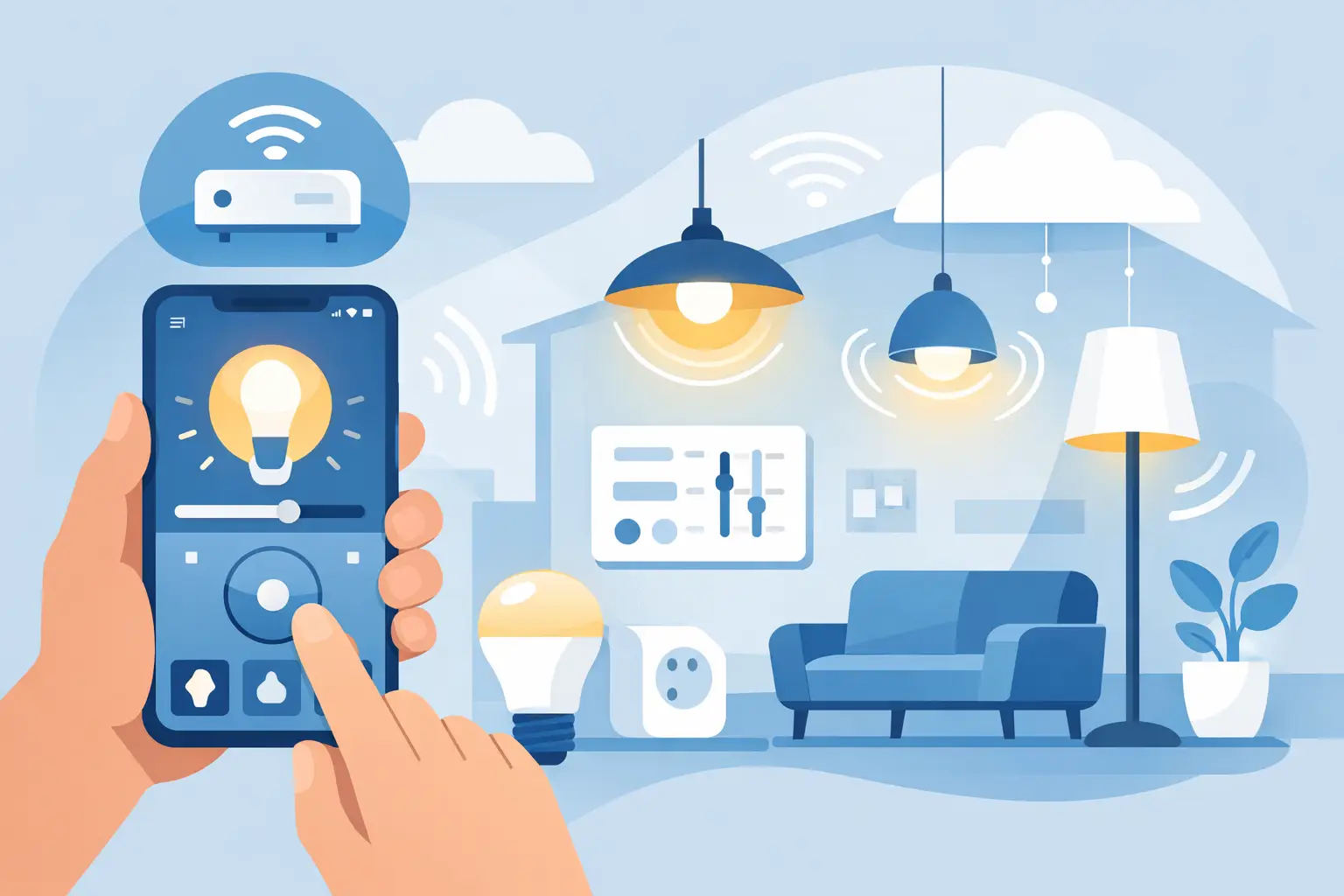
If you have ever walked into a meeting room with lights blazing at midday, or come home and realised half the house was left lit for no reason, you have already seen where a smart lighting control system earns its keep. Good lighting should do more than switch on and off. It should respond to how a space is used, support safety, reduce wasted energy and make everyday routines easier.
For homeowners, landlords and business owners, that matters for different reasons. At home, it is about convenience, comfort and a better finish to a renovation. In rental properties and commercial buildings, it is often about efficiency, consistency and reducing avoidable costs. In both cases, the right setup needs proper design and proper installation. Smart controls are only useful when they work reliably, safely and in a way that fits the building.
What is a smart lighting control system?
A smart lighting control system is a setup that lets lighting be managed automatically, remotely or through programmed scenes rather than by basic manual switching alone. That can include app control, wall keypads, motion sensors, daylight sensors, timers and integration with wider electrical systems.
The main point is not the technology itself. The point is control. Instead of every light operating as a simple standalone circuit, the system allows lighting to behave in a planned way. Hallway lights can come on only when needed. External lights can follow daylight levels. Office lighting can be zoned so empty areas are not lit unnecessarily. In a home, one button can set an evening scene across the kitchen, dining area and lounge.
Some systems are quite simple, such as a few smart switches or dimmers. Others are more advanced and designed around larger properties, offices, communal areas or mixed-use buildings. The right approach depends on the building, the wiring, the client’s priorities and how much flexibility is needed in the long term.
Why more properties are moving to smart lighting control
The biggest reason is practical value. Lighting is used every day, often in the same patterns, and that makes it one of the easiest areas to improve. A well-planned system can help reduce unnecessary usage without making the building harder to live or work in.
There is also a clear usability benefit. In larger homes, open-plan spaces and commercial premises, lighting circuits can become awkward very quickly. You end up with too many switches, poor zoning or lights controlled from the wrong places. Smart controls simplify that. Instead of adapting your habits to the wiring, the wiring is configured around how the space is actually used.
For landlords and property managers, there is another advantage. Shared areas, corridors, external access routes and bin stores are common sources of wasted energy and maintenance complaints. Timed or sensor-based lighting can improve reliability while limiting unnecessary running hours. That does not remove the need for compliant emergency lighting where required, but it can improve day-to-day operation significantly.
Where a smart lighting control system works best
In homes, smart lighting tends to deliver the most value in kitchens, loft conversions, extensions, garden rooms and open-plan living areas. These spaces often serve more than one purpose, so a single on-off switch is rarely the best answer. Cooking, dining, entertaining and relaxing all need different lighting levels.
In commercial settings, reception areas, meeting rooms, open-plan offices, retail spaces and communal corridors are all strong candidates. These are the areas where occupancy changes throughout the day and lighting demand is less predictable. A better control strategy reduces waste and gives staff or tenants a more consistent experience.
For HMOs and multi-unit properties, the system needs a more careful approach. Ease of use matters, but so does durability, tamper resistance and compliance with the wider electrical installation. The best solution is usually one that balances control with simplicity. Too much complexity often causes more issues than it solves.
The core features that make a difference
Not every smart feature is worth paying for. The best systems focus on what improves day-to-day use.
Zoning is usually the first major improvement. It allows different parts of a room or building to be controlled independently, which is especially useful in larger areas or spaces with changing natural light.
Dimming is another key feature, but only when it is matched correctly with the light fittings and drivers. Done properly, it improves comfort, mood and energy efficiency. Done badly, it can lead to flickering, buzzing or poor lamp performance.
Sensors are often where the real savings come from. Occupancy sensors, absence detection and daylight harvesting can all reduce wasted usage. These features are particularly effective in toilets, store rooms, corridors and meeting areas that are not in constant use.
Scene control is more about convenience than savings, but it can transform how a space feels. In homes, scenes can support different routines throughout the day. In businesses, they can help standardise lighting for presentations, cleaning or opening and closing procedures.
Remote access can be useful too, though it is not essential in every project. Some clients want full app-based control and scheduling. Others prefer local control with a few automated functions. Neither is inherently better. It depends on who will use the system and how comfortable they are with technology.
Planning matters more than the product
This is where many lighting upgrades go wrong. People focus on a brand or app before thinking about the actual layout, circuit design and user experience. A smart lighting control system should begin with the building, not the gadget.
A proper assessment looks at how each area is used, where switching points are needed, what type of fittings are being installed and whether the existing wiring supports the intended control method. In some properties, retrofitting smart controls is straightforward. In others, it may need rewiring, new switch drops, additional containment or changes at the consumer unit.
Wireless systems can reduce disruption, but they are not always the best answer. They can be very effective in finished properties where chasing walls is undesirable. That said, hardwired systems often offer stronger long-term reliability for larger or more complex installations. The decision should be based on the site conditions and performance requirements, not just installation speed.
Smart lighting control system choices for homes and businesses
Domestic and commercial projects often need different priorities. In a family home, ease of use and atmosphere usually come first. Clients want lighting that feels intuitive, not something that turns basic tasks into a software exercise. The strongest results usually come from simple controls, sensible scenes and well-planned switching.
In offices, rental properties and shared buildings, reliability and repeatability are often more important than visual effect. Facilities managers and landlords want systems that occupants can understand quickly, with minimal scope for misuse or confusion. Maintenance access, replacement compatibility and future adjustments should all be considered early on.
This is why a one-size-fits-all package rarely works. A detached house renovation in Kent, a Central London office fit-out and a communal area upgrade in a block of flats may all use smart lighting, but they should not be designed in the same way.
Installation, safety and compliance
Lighting controls sit within the wider electrical installation, so safety cannot be treated as an afterthought. Load calculations, circuit protection, compatibility with LED drivers, switch gear quality and testing all matter. If emergency lighting, fire alarm interfaces or commercial compliance requirements are involved, the design becomes even more important.
That is also why professional installation matters. Poorly fitted control systems can create nuisance faults, unreliable switching and unnecessary call-backs. Worse still, hidden issues in existing wiring can be missed if the focus is only on the visible accessories.
An experienced electrical contractor will look beyond the faceplates and software. They will assess whether the existing infrastructure is suitable, identify any remedial works needed and install the system in a way that supports both present use and future maintenance. For clients across London and Kent, that practical, end-to-end approach is usually what makes the difference between a system that impresses on day one and one that still works properly years later.
Is it worth the investment?
Usually, yes - but the return is not identical in every property. In a busy commercial space with long operating hours, the savings and usability gains can be significant. In a home, the value may come more from convenience, presentation and flexibility than dramatic energy reduction.
There are trade-offs. A more advanced system costs more upfront. Retrofitting can involve extra labour if the existing installation is outdated. Some clients also prefer physical switches over app control, which means the design needs to stay grounded in everyday use rather than novelty.
The best results come from being honest about what you want the system to do. If the goal is lower running costs, focus on sensors, zoning and scheduling. If the goal is a better living environment, scenes, dimming and thoughtful placement will matter more. If the goal is managing a rental or commercial building more efficiently, durability and ease of operation should lead the specification.
A smart lighting control system is not about filling a property with technology for its own sake. It is about making the lighting work properly for the people using the space. When it is planned well, installed correctly and matched to the building, it becomes one of the most useful upgrades you can make. If you are considering it, start with how the space needs to function and let the electrical design follow that lead.