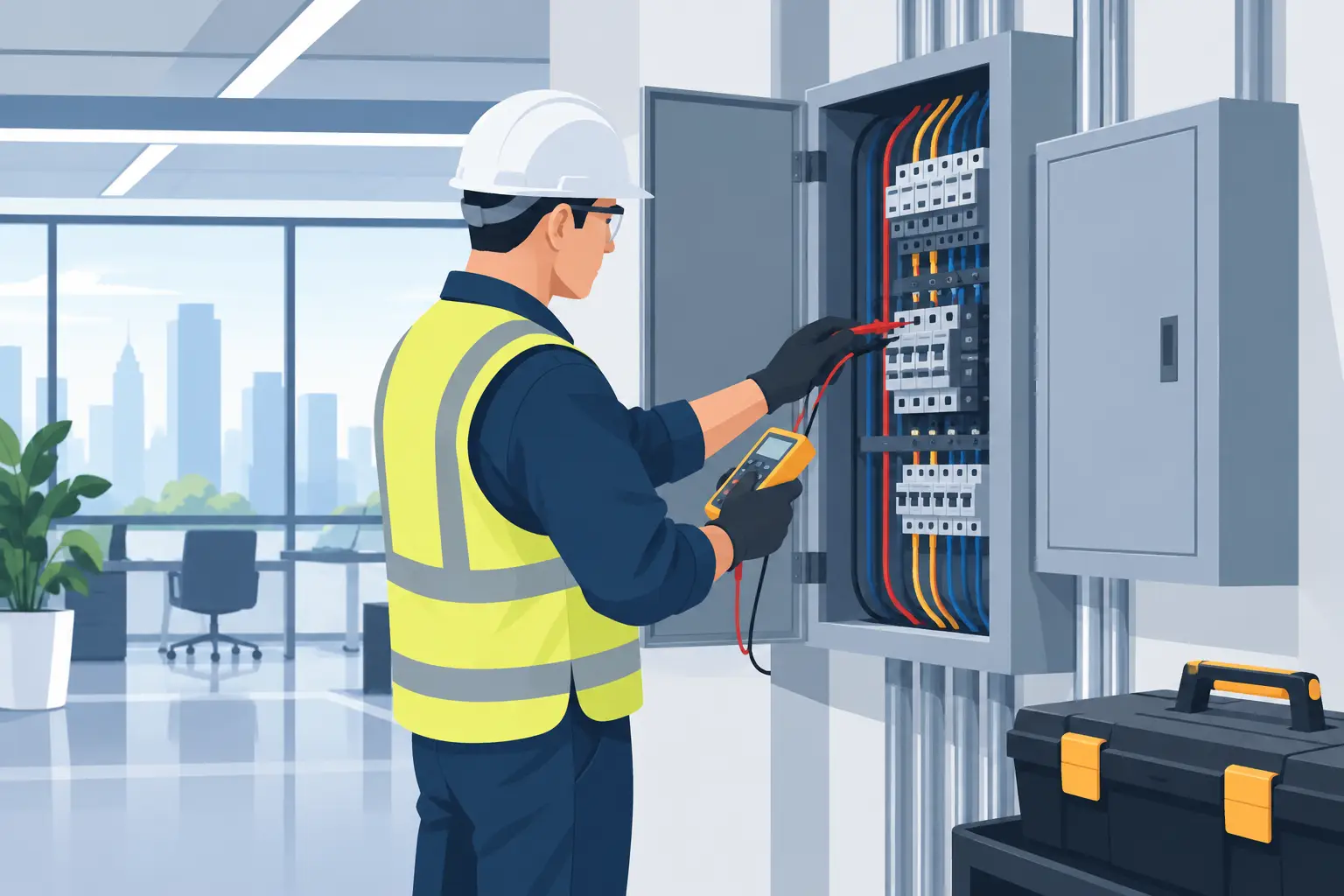
A tripped circuit at opening time, an emergency light that fails during an evacuation, or repeated faults in a distribution board can quickly become more than an inconvenience. This guide to commercial electrical maintenance explains how business owners, landlords and property managers can keep electrical systems safe, compliant and dependable without waiting for a costly breakdown.
Commercial premises place constant demands on their electrics. Offices rely on IT equipment, lighting and heating controls. Shops use display lighting, refrigeration and payment systems. HMOs, managed blocks and industrial units may need shared supplies, fire alarm interfaces, emergency lighting and more complex distribution. A planned approach gives you better control over risk, disruption and expenditure.
What commercial electrical maintenance should cover
Commercial electrical maintenance is the ongoing inspection, testing, servicing and repair of an installation and the equipment connected to it. It is not simply responding when the power goes off. A good maintenance programme identifies deterioration before it creates an unsafe condition, affects day-to-day operations or leaves a responsible person exposed to compliance issues.
The right scope depends on the building, how it is used, the age and condition of the installation, and the equipment in place. A small office with modern wiring requires a different plan from a busy restaurant, warehouse or multi-let property. However, most programmes should consider fixed wiring, distribution boards, protective devices, lighting, emergency lighting, fire alarm-related electrical supplies, portable appliances and any specialist systems such as EV chargers or access control.
Maintenance also needs to account for changes. Added workstations, new machinery, tenant alterations and extensions can all increase electrical load. If circuits are repeatedly tripping after a change in use, the answer is not always a larger fuse or a reset. The installation may need assessment to confirm that circuit capacity, cable sizing and protective measures remain suitable.
Start with an accurate picture of the installation
Before setting a maintenance schedule, establish what is installed and what condition it is in. For a newly acquired property or an older building with incomplete records, an Electrical Installation Condition Report, commonly called an EICR, is often the sensible starting point. It assesses the safety of the fixed installation and highlights observations that need attention.
An EICR is not a maintenance contract in itself. It is a detailed condition assessment at a point in time. Its findings should be used to prioritise remedial work and create a practical plan for future checks. If the report identifies issues coded as dangerous or potentially dangerous, these should be addressed promptly rather than left until the next planned visit.
Keep the report, certificates, circuit schedules and details of remedial work in one accessible record. This is particularly useful for landlords, facilities managers and multi-site operators. Clear documentation helps when contractors attend, tenants report faults, insurers request evidence or responsibility changes hands.
Check whether your circuit information is still accurate
Distribution boards should have clear, legible circuit schedules. In many commercial properties, labels no longer match the circuits they serve after years of alterations. That slows fault finding and can create risk when someone needs to isolate equipment safely.
A maintenance electrician can trace and update circuits where necessary. This is a relatively straightforward task compared with the lost time and uncertainty caused by an incorrectly labelled board during an urgent callout.
Build a schedule around risk, not guesswork
There is no single maintenance interval that suits every premises. Testing frequencies should reflect the type of installation, environmental conditions, occupancy, previous findings and the level of wear. A clean, low-traffic office will normally have different requirements from a commercial kitchen, workshop or rental property with frequent tenant turnover.
Your plan should separate routine visual checks from formal inspection and testing. Staff or site managers can be trained to notice obvious concerns, such as damaged sockets, loose faceplates, overheating smells, flickering lights or extension leads being used as permanent wiring. Formal testing and electrical work should be completed by a competent electrician with the right test equipment and experience.
For portable appliances, PAT testing can form part of the programme where equipment is supplied by the business or landlord. It is not just a matter of attaching pass labels. The level and frequency of inspection should match the appliance, its use and the environment. A kettle in a low-use office kitchen is not exposed to the same risk as power tools used daily on a site.
A sensible maintenance calendar may include the following areas:
- Periodic inspection and testing of fixed wiring, with EICR intervals based on the property and its use.
- Visual and functional checks for emergency lighting, supported by the required formal tests and records.
- Testing and maintenance of fire alarm systems and associated electrical components.
- Risk-based inspection and testing of portable appliances.
- Planned checks of distribution boards, local isolators, external lighting, EV charging equipment and data or power supplies affected by alterations.
The exact frequency should be agreed after an assessment of your premises. Over-testing can add unnecessary cost and disruption, while under-testing can allow faults to develop unnoticed.
Give emergency lighting and fire safety systems proper attention
Emergency lighting is easy to overlook because it is designed to operate when normal lighting fails. That is exactly why it needs regular testing. Batteries degrade, fittings become damaged, lamps fail and changes to room layouts can leave escape routes poorly covered.
Testing should confirm that emergency luminaires operate, remain illuminated for the required duration and still provide suitable coverage for escape routes, stairs, corridors and exit points. Records matter. If an incident occurs, a written test log shows that checks were completed and faults were acted upon.
Fire alarm systems require the same disciplined approach. Electrical maintenance may involve checking supplies, isolators, interfaces and any electrical works that could affect the system. Work should always be coordinated so essential life-safety systems are not left impaired without suitable controls in place. If testing requires a temporary shutdown, plan it around occupancy and make responsible staff aware.
Respond early to warning signs
Electrical faults rarely arrive without clues. Repeated tripping, buzzing from a board, warm sockets, burning smells, discoloured accessories and lights that flicker or dim should all be investigated. So should nuisance tripping after new equipment is installed. Simply resetting a protective device may restore power, but it does not establish why it operated.
Staff need a clear reporting route for electrical concerns. Encourage them to report small changes before they become failures, and make sure they know not to attempt repairs or interfere with distribution equipment. For a serious concern, isolate the affected equipment where it is safe to do so and arrange urgent professional support.
A 24/7 response is particularly valuable where a fault affects security, refrigeration, critical IT equipment, emergency systems or tenant safety. Even then, the best outcome is not merely getting the power back on. The cause should be identified, repaired and recorded so the same issue does not keep returning.
Plan maintenance around business operations
The strongest maintenance programmes reduce disruption rather than create it. Schedule planned testing outside peak trading hours where practical, but do not assume every job can be completed overnight. Larger inspections may require circuits to be isolated for safe testing, and that should be agreed in advance.
A clear quotation and work plan should set out what will be tested, likely access requirements, any expected shutdowns, exclusions and what happens if defects are found. This gives managers time to notify occupiers, protect sensitive equipment and arrange access to locked areas.
Where repairs are needed, prioritise them by safety and operational impact. A damaged accessory in a low-use store cupboard may be a straightforward planned repair. A fault affecting emergency lighting, a distribution board or an area open to the public may need immediate attention. Transparent advice helps you spend money where it reduces the greatest risk first.
Choose an electrical contractor who can support the full cycle
Commercial maintenance works best when the contractor understands the site over time. They can identify recurring faults, track changes, maintain clear records and advise when repair is still sensible or when replacement offers better value.
Look for a contractor that can handle assessment, testing, remedial work and emergency attendance, rather than treating each stage as a separate problem. PG Electrical supports commercial clients across Greater London, Central London and Kent with planned electrical work, compliance testing and urgent fault response. That continuity can make a real difference when a fault needs rapid diagnosis or a report identifies work that cannot wait.
Ask how findings will be explained, how pricing is agreed and whether certificates and reports will be provided promptly. Technical language has its place, but the decision-maker should receive a clear explanation of the risk, the available options and the recommended next step.
Keep maintenance records useful
A folder full of certificates is only useful if it helps you manage the property. Record inspection dates, test results, defects, completed repairs, equipment changes and upcoming due dates. For larger sites, include asset locations and contact details for the person responsible for access.
Review the record after alterations, changes in occupancy or significant new electrical loads. A maintenance plan that was appropriate two years ago may no longer match the building. Regular attention, accurate records and prompt action on warning signs will keep your premises safer, reduce avoidable downtime and give you a clearer basis for every electrical decision.