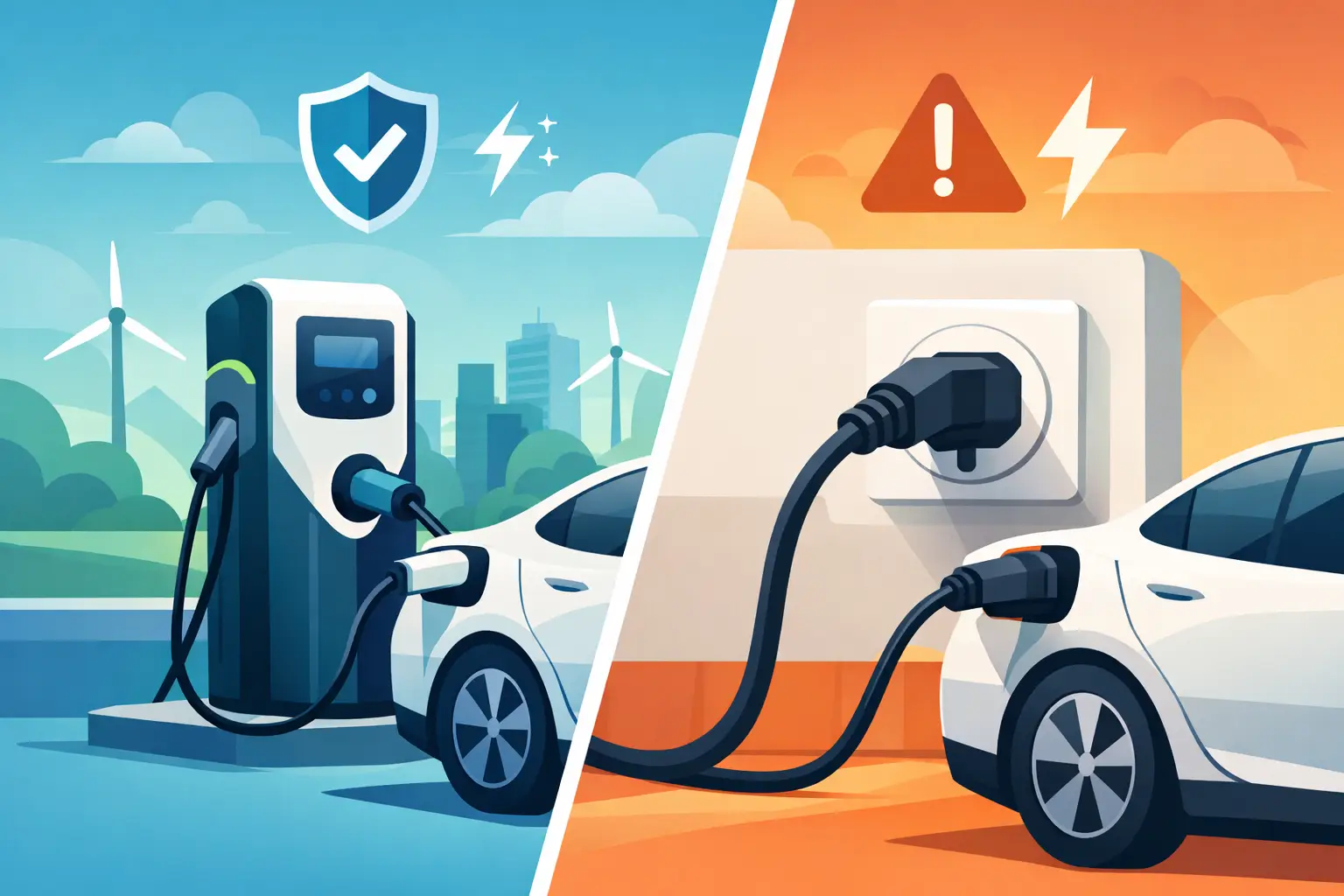
A plug-in car can technically charge from a standard three-pin socket, but that does not make it the right long-term arrangement. In the EV charger vs socket charging decision, the main differences are safety under sustained load, charging speed, convenience and the condition of your property’s electrical installation. For most drivers who charge at home regularly, a dedicated EV charger is the safer and more practical choice.
A standard socket may have a role for occasional or emergency charging. However, it was not designed with the expectation of supplying a high electrical load for many hours, night after night. A professionally specified charge point is designed for that job and should be assessed as part of the wider electrical system, rather than treated as another appliance plugged into the wall.
EV charger vs socket charging: the essential difference
A domestic EV charge point is connected to its own dedicated circuit at the consumer unit. It includes controls that communicate with the vehicle, manage charging safely and disconnect the supply if a fault is detected. A competent installer will also consider circuit protection, earthing arrangements, cable routes, load capacity and the location of the unit before work begins.
Socket charging normally uses the portable charging lead supplied with the vehicle. This lead contains an in-cable control device, which provides a degree of protection and limits the charging current. That is helpful, but it does not change the fact that the final connection is a standard socket outlet and the circuit behind it may also supply other equipment.
The issue is not that every socket charge is automatically unsafe. A sound, modern socket on a suitable circuit can be used for limited charging in line with the vehicle manufacturer’s guidance. The concern is repeated, prolonged use. Heat at worn contacts, loose terminals, older wiring, overloaded circuits and unsuitable extension leads can all increase the risk of damage or failure.
Safety comes before charging speed
Electric vehicles draw a substantial load continuously. A three-pin socket is commonly protected at 13 amps, although many portable EV leads charge at around 10 amps. At that level, a typical electric car may receive roughly 2.3 kW of power. Charging a larger battery from low to full can therefore take well over 20 hours, depending on the vehicle, battery size and starting charge.
A common home charge point is rated at 7.4 kW. Subject to the property having an appropriate single-phase supply and sufficient capacity, this can often add around 25 to 30 miles of range per hour. It is not simply faster. It gives the vehicle a dedicated, purpose-designed supply that is more suited to overnight routine charging.
A proper installation also addresses safety measures that a plug-in arrangement cannot provide on its own. These may include a dedicated protective device, appropriate residual current protection, suitable isolation and consideration of the property’s earthing system. Where required, the charge point or installation design must also protect against risks associated with a PEN conductor fault on certain UK electricity supplies.
This is why a visual check of the nearest socket is not enough. The socket may look new while the circuit, connections or consumer unit require attention. A qualified electrician should assess the complete installation.
Why extension leads are not a solution
An EV charging lead should not be run through a standard extension lead, reel or multi-way adaptor. These products can overheat when used continuously at high load, especially where the cable is coiled, damaged, undersized or exposed to weather.
Charging cables should also be protected from trip hazards, crushing and water ingress. A lead trailing across a pavement, communal route or doorway is both an electrical and practical problem. For homes without off-street parking, the right answer may involve reviewing available charging options rather than attempting an unsafe temporary setup.
What a dedicated EV charger offers
A fitted charger gives more control over when and how a vehicle charges. Many units can schedule charging around off-peak electricity tariffs, helping households use lower-cost overnight energy where available. Some can monitor household demand and reduce charging output if the property is approaching its supply limit.
That load management can be particularly valuable in homes with electric showers, induction hobs, heat pumps or other high-demand equipment. Rather than guessing whether the installation can cope, the charger can be specified around the actual electrical capacity of the building.
A charge point also keeps the setup tidy and repeatable. The cable is stored at the parking area, the connection is weather-rated for its intended position and the vehicle can be charged without opening a window, routing a lead through the home or relying on a socket in a garage. For regular EV ownership, those details make a noticeable difference.
There is an upfront installation cost, and it is fair to factor that in. Cable length, consumer unit condition, parking location, groundworks and the available incoming supply all affect the final price. However, the cost should be compared with years of safer, quicker and more predictable charging, not just with the price of using an existing socket.
When socket charging may be reasonable
Socket charging can be a sensible short-term option for some drivers. For example, it may suit a plug-in hybrid with a small battery, a vehicle used only occasionally, or a homeowner waiting for a charge point installation. It can also provide a useful backup when away from a regular charging location.
The arrangement should still be treated carefully. Use the manufacturer-supplied portable charging lead, connect directly to a sound socket, avoid adaptors and extension leads, and check the plug and socket for unusual warmth during early use. If a socket becomes hot, discoloured, loose or intermittently cuts out, stop using it and arrange an inspection.
Older properties deserve particular caution. Many homes across London and Kent have had alterations over decades, and not every circuit is suitable for sustained EV charging. A previous EICR or consumer unit upgrade may provide useful information, but it does not replace a charging-specific assessment where the supply demand or cable route has changed.
Installation considerations for homeowners
A reliable EV charger installation begins with the property, not the box on the wall. An electrician should establish where the vehicle parks, how the cable will be routed, the rating and condition of the consumer unit, and whether the existing supply has enough available capacity.
For a driveway installation, the preferred route is often from the consumer unit to a charger mounted near the parking bay. The route needs to be mechanically protected and neatly finished, whether it passes through walls, loft spaces, garages or external areas. The charger’s location should allow the vehicle to connect without creating a trip hazard or stretching the cable.
Homes with limited supply capacity may need a more detailed solution. Load balancing can sometimes avoid the need for a supply upgrade, while other properties may require discussion with the distribution network operator. The correct option depends on the measured demand, not assumptions based on the size of the house.
PG Electrical can assess the condition of the installation, explain the practical options and provide a clear quotation before work starts. That approach helps avoid unexpected changes once the installation is under way.
Landlords, flats and commercial premises
For landlords and property managers, EV charging should be considered alongside wider electrical compliance. A dedicated charger adds a new high-load circuit, so it must be designed, installed and certified correctly. In rental properties, clear responsibility for electricity costs, access and maintenance should also be agreed from the outset.
Flats and shared parking areas can be more complex than a single driveway. The electrical supply may be communal, parking spaces may not sit beside the building, and a charger for one resident can affect future demand for others. A planned approach can reduce the need to reopen finished areas when more charging points are requested later.
Businesses should consider how charging will be used: staff-only parking, visitor charging, fleet vehicles or a mixture. A small office may only need a few managed points, while a light industrial site with vans returning each evening may require load studies, phased installation and capacity planning. Faster charging is not automatically better if the site supply cannot support it safely.
Choosing the right option for your routine
If you drive daily, have off-street parking and expect to keep an EV for the foreseeable future, a dedicated charge point is usually the clear choice. It provides a safer long-term connection, cuts charging time and makes it easier to use off-peak tariffs.
If you only need to top up a small battery occasionally, socket charging may be adequate for a limited period, provided the circuit is verified as suitable and the manufacturer’s instructions are followed. It should not become a workaround for an installation that needs attention.
The best starting point is a site assessment that looks at your vehicle, parking position, existing electrical system and expected charging pattern. That gives you a charging arrangement that works properly from the first night, rather than one that leaves you watching a warm plug or calculating whether the car will be ready by morning.