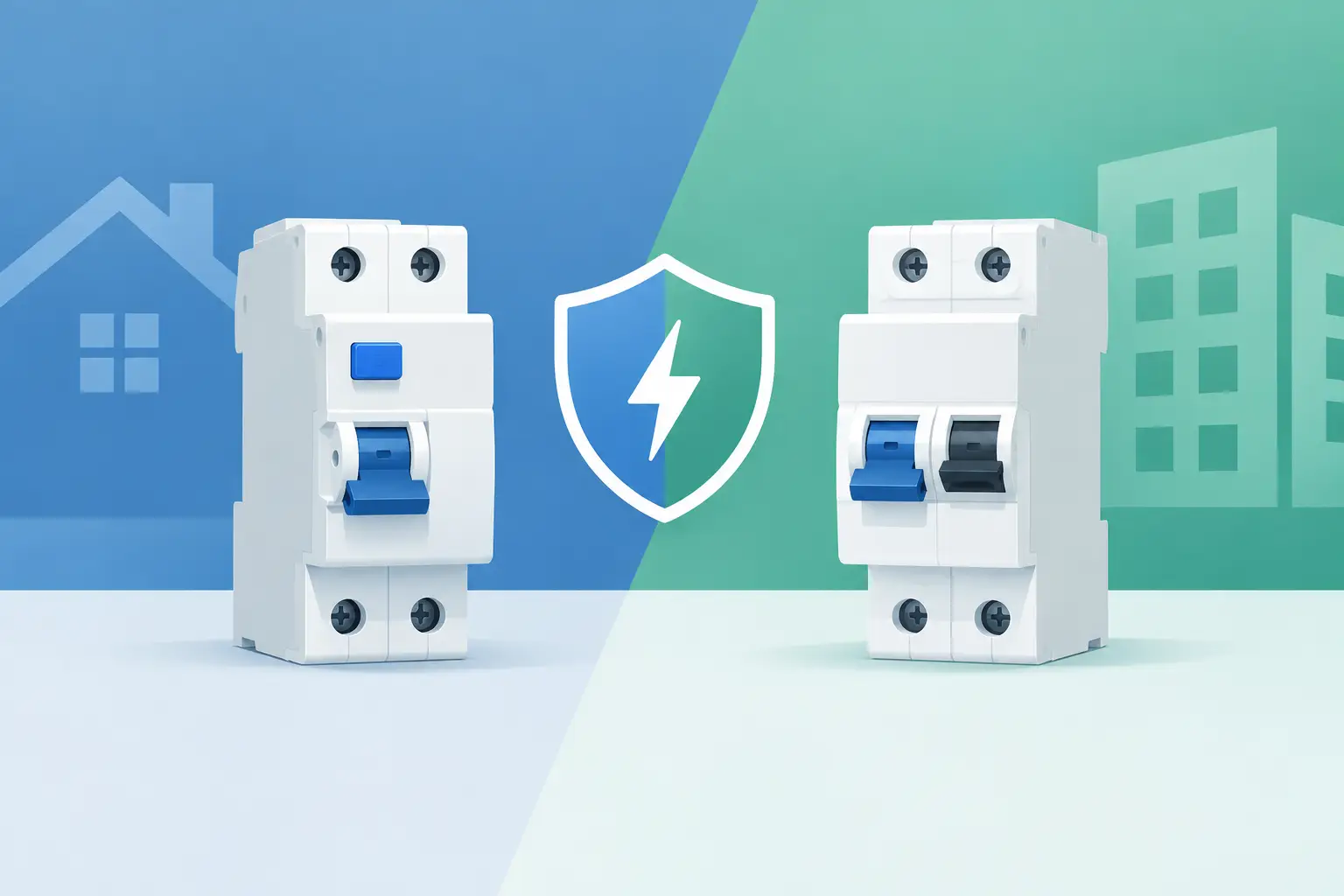
A consumer unit should not leave an entire property in darkness because one appliance develops a fault. That practical concern sits at the heart of the RCD versus RCBO decision. Both devices are designed to reduce the risk of electric shock and fire from earth faults, but they protect circuits in different ways - and the difference matters when you are planning a new installation, consumer unit upgrade or remedial work following an EICR.
For homeowners, landlords and business owners, the right arrangement is rarely about choosing the cheapest component. It is about keeping people safe, meeting current wiring requirements where applicable, and limiting disruption when a fault occurs.
What an RCD does
An RCD, or residual current device, monitors the electrical current flowing through a circuit. Under normal conditions, the current flowing out on the live conductor should match the current returning on the neutral conductor. If some current escapes to earth - potentially through damaged cable insulation, a faulty appliance or a person - the RCD detects the imbalance and disconnects the supply very quickly.
This additional protection can significantly reduce the danger of a serious electric shock. It can also help reduce fire risk where leakage current develops in an installation.
In many consumer units, one RCD protects a group of circuits. A typical split-load board may have an RCD serving several socket, lighting or other final circuits, alongside MCBs that provide overcurrent protection for each individual circuit.
An RCD does not replace an MCB, fuse or circuit breaker. It does a different job. An MCB responds to overloads and short circuits, while an RCD responds to current leaking to earth.
What an RCBO does
An RCBO combines two functions in one device: residual current protection and overcurrent protection. In simple terms, it performs the role of both an RCD and an MCB for one individual circuit.
Each circuit fitted with an RCBO has its own protection against earth leakage, overload and short circuit faults. If a fault develops on the kitchen socket circuit, for example, that RCBO should disconnect that circuit while the lighting, heating controls and other circuits remain available.
That circuit-by-circuit protection is the main reason RCBO consumer units are widely specified for new installations and upgrades. They offer a more targeted response to faults and can make a building easier to manage after a trip.
RCD versus RCBO: the practical difference
The most noticeable difference is what happens when there is a fault. With a shared RCD, one fault can trip the device and switch off every circuit connected to it. A faulty kettle, outdoor socket or damaged appliance may therefore take out several areas of the property at once.
With RCBOs, the affected circuit is normally isolated on its own. This is particularly valuable in larger homes, rental properties, offices, shops and premises where loss of power could affect security systems, refrigeration, IT equipment, emergency arrangements or day-to-day trading.
There is also a fault-finding benefit. If a single RCBO has tripped, an electrician can identify the relevant circuit immediately and begin testing from a clearer starting point. A shared RCD trip can require more investigation because several circuits may be involved.
Neither option makes poor workmanship acceptable. Correct circuit design, earthing, bonding, testing and certification remain essential. A quality protective device must be selected, installed and tested properly to do its job.
Why RCBOs are often the preferred choice
RCBOs usually provide better continuity of supply. That may sound technical, but the benefit is straightforward: a fault in one place is less likely to affect everything else.
For a homeowner, this might mean the upstairs lights stay on when an appliance trips a downstairs socket circuit. For a landlord, it can reduce disruption for tenants and make electrical faults easier to report. In a commercial setting, it can help prevent a minor fault from interrupting several work areas at the same time.
Modern consumer units using RCBOs can also be arranged to give each final circuit appropriate additional protection. This supports a cleaner, more resilient installation and avoids placing too many unrelated circuits behind one shared RCD.
However, RCBOs are more expensive than separate MCBs combined with shared RCD protection. A full RCBO board can increase the upfront cost of a consumer unit replacement. The final price also depends on the number of circuits, the type of supply, surge protection requirements, condition of existing wiring and any remedial work identified during testing.
For many properties, the reduced inconvenience and improved fault separation justify that investment. For others, especially where a system has a small number of circuits and a limited scope of work, another compliant arrangement may be appropriate.
When a shared RCD arrangement may still be suitable
An RCD-protected consumer unit is not automatically unsafe or obsolete simply because it does not use RCBOs. Existing installations should be assessed on their condition, design, test results and intended use.
A properly installed and tested split-load board may continue to provide effective protection. It may also be practical where only limited alterations are being made and the existing consumer unit has suitable capacity, protection and test results.
The decision changes where there are repeated nuisance trips, poor circuit separation, an old fuse board, inadequate protection, signs of overheating, damaged accessories or failed EICR observations. In these cases, replacing or upgrading the consumer unit may be safer and more cost-effective than repeatedly repairing around an ageing installation.
Landlords and duty holders should be especially careful not to treat an RCD trip as a minor inconvenience. A device that trips repeatedly is responding to a condition that needs investigation. Resetting it without establishing the cause can leave a developing fault unresolved.
Type matters, not just RCD or RCBO
The label alone does not tell the whole story. RCDs and RCBOs are available in different types, selected according to the electrical equipment connected to the circuit.
Type A devices are commonly used in modern installations because many everyday products contain electronic components that can produce pulsating DC residual currents. This can include appliances, LED lighting drivers, induction hobs and some charging equipment. Other applications may require different arrangements or specialist assessment, particularly where EV charging, solar generation, battery storage or industrial equipment is involved.
There are also differences in sensitivity and time delay. A 30 mA device is commonly used for additional protection on final circuits, but the right specification depends on the circuit design and applicable requirements. This is why consumer unit work should not be treated as a like-for-like swap of devices without proper inspection, testing and design consideration.
What this means for landlords and businesses
Electrical safety is not only about avoiding a power cut. For rented and commercial premises, reliable protective arrangements support compliance, safe operation and quicker response when something goes wrong.
In an HMO or managed block, a fault that removes lighting or sockets from multiple areas can create unnecessary disruption for occupants and maintenance teams. In an office, shared RCD protection may mean a fault on a kitchenette appliance affects staff workstations. In a shop, it could interrupt equipment that has no connection to the original fault.
RCBOs cannot prevent every outage, but they can contain many circuit faults to the area where they occur. Where continuity of supply is important, that is a meaningful advantage.
Any work should be supported by appropriate inspection, testing and certification. An EICR is useful where there is uncertainty about the condition of an existing installation, while a consumer unit replacement requires a full assessment of the installation it will serve. Fitting a new board does not correct hidden issues in old cables, accessories or earthing arrangements.
How to choose the right protection
Start with the condition and purpose of the property, not the device price. A domestic consumer unit upgrade may benefit from RCBO protection on every circuit, particularly where the existing board is dated or nuisance tripping has become a problem. A landlord may prioritise clear fault separation for tenants. A business may need to consider critical circuits, operating hours and the consequences of lost power.
A qualified electrician should inspect the existing installation, confirm the earthing and bonding arrangements, review circuit loading and identify any work needed before a new consumer unit is fitted. They can then recommend an RCD or RCBO configuration that is suited to the building, equipment and budget.
PG Electrical approaches this work with clear quotations, proper testing and practical advice, whether the requirement is a planned upgrade or an urgent fault investigation. The aim is not to add unnecessary equipment, but to provide protection that performs reliably when it is needed.
A final point before you upgrade
If your RCD trips, your lights flicker, sockets lose power without explanation or an EICR has raised concerns about the consumer unit, arrange a professional inspection rather than relying on repeated resets. The right protective device is only part of the answer; a safe installation depends on finding the reason a fault occurred and putting it right properly.